
Most articles about using AI in daily life give you a numbered list. Thirty-eight examples. Forty-two tools. A table of features and pricing tiers.
You read it, feel briefly informed, close the tab, and change nothing.
This guide works differently. It is built around one insight that the listicle articles miss entirely: you do not adopt AI by learning about it. You adopt it by feeling a single moment of genuine relief — the moment a task that used to cost you 25 minutes resolves in 90 seconds — and then chasing that feeling until it becomes instinct.
I spent seven years writing about productivity and digital behavior before AI made most of that writing feel quaint. What I can tell you with confidence is that the people who have integrated AI most naturally into their lives did not take a course, read a comparison chart, or set up an elaborate system. They started with one problem on one morning and let curiosity do the rest.
This is how you do that.
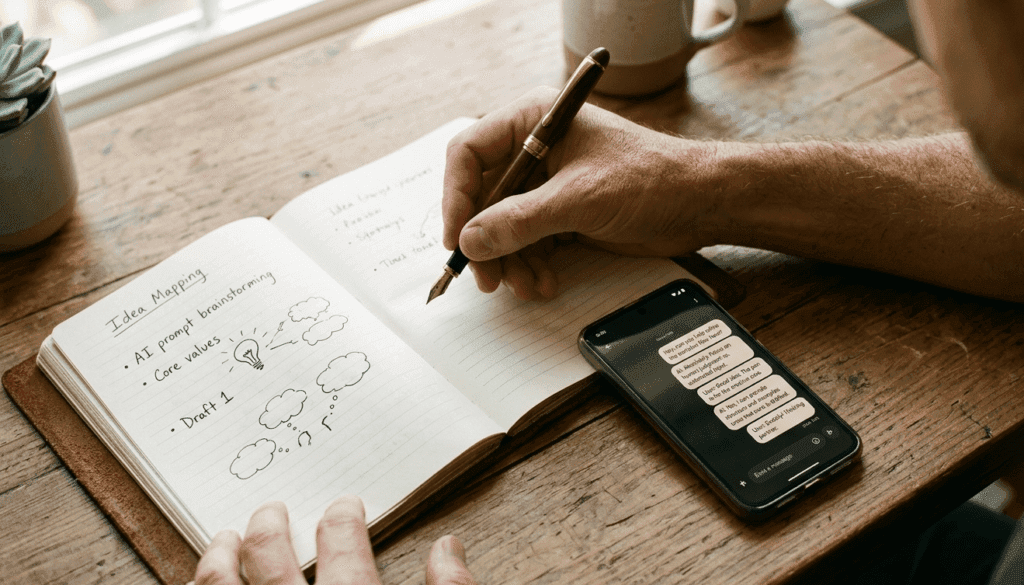
What Is the Simplest Way to Begin Using AI in Your Daily Life?
The simplest way to begin using AI daily is to identify one task you repeat every day — writing a message, searching for an answer, making a list — and do it through an AI tool instead of your current method. Just once. That single experience, if it genuinely saves you time, creates more behavioral change than any tutorial ever will.
The mistake most beginners make is trying to learn AI as a subject before using it as a tool. They watch explainer videos, compare features, and read about prompt engineering before ever sending a single message. That is the wrong order. The knowledge that sticks comes after the experience that surprises you.
Pick one task. Do it once. Let the result speak.
Everything I am about to cover in this guide will land far more concretely after you have had that first moment. If you have not had it yet, open Claude, ChatGPT, or Gemini right now, type your most annoying recurring task, and ask for help. Come back in five minutes. You will read the rest of this differently.
How Does AI Actually Reduce Decision Fatigue Throughout Your Day?
AI reduces decision fatigue by absorbing the low-stakes decisions that collectively drain your mental energy — what to cook, how to phrase a difficult message, which tasks to prioritize — so your cognitive resources are preserved for the decisions that genuinely require your judgment and experience.
This is the mechanism that almost no competitor article discusses, and it is the most important practical benefit of daily AI use.
Decision fatigue is real and well-documented. Every choice you make — however minor — draws from the same finite pool of mental energy. By midafternoon, most people are making materially worse decisions than they were at 9am, not because they are less intelligent, but because the pool has been drawn down by hundreds of micro-choices since breakfast.
AI absorbs those micro-choices. What should I have for dinner given what is already in the fridge? How do I respond to this passive-aggressive email without escalating the situation? Which of these five tasks should I do first given my energy level right now? These are exactly the questions AI handles well — and exactly the questions that, unanswered, create the low-grade friction that drains an otherwise productive day.
When you stop spending mental energy on questions AI can answer, you arrive at your most important decisions less depleted. That is not a small benefit. Over weeks and months, it changes the quality of your thinking.
Can AI Genuinely Help With Work Without Making Your Output Feel Generic?
AI helps with work without producing generic output when you treat it as a drafting collaborator rather than a ghostwriter — giving it your specific context, your actual opinions, your preferred tone, and then editing its response back through your own judgment before it represents you in the world.
The most sophisticated users are no longer using AI in short bursts for isolated tasks — they are integrating it into longer stretches of focused work Mypulse, and the quality gap between those who prompt well and those who prompt lazily is widening fast.
Here is the practical difference. A lazy prompt: “Write me an email declining this meeting.” A professional’s prompt: “I need to decline a meeting request from a senior colleague I respect. I want to sound genuinely regretful, briefly cite a real scheduling conflict, and offer a specific alternative. My usual tone is direct but warm. Draft three options and label them by how formal each one reads.”
The second prompt produces something you might actually send. The first produces something that sounds like everyone else’s AI-generated email, which recipients are now perfectly capable of recognizing.
Your voice is not lost to AI. It is multiplied by it — provided you remain the editor in chief of everything that leaves your name.
How Do You Build an AI Habit That Actually Sticks?
You build a sustainable AI habit by anchoring it to an existing daily trigger — your morning coffee, the start of your workday, or any recurring task — and using AI at that exact moment every day for two weeks until the reach becomes automatic, the same way any behavioral habit forms through consistent repetition at a consistent cue.
Habit science is clear on this: new behaviors attach to existing routines far more reliably than they emerge from willpower alone. You do not build a gym habit by deciding every morning to go to the gym. You build it by putting your shoes by the door and going immediately after breakfast — every day, without negotiating with yourself.
AI habits work identically. The most natural daily AI users I know did not decide to use AI more. They decided that their morning email review now happened through AI. Or that every meeting ended with an AI-generated summary. Or that dinner planning happened in a 90-second conversation with an assistant rather than a twenty-minute scroll through recipe sites.
One anchor. Consistent cue. Two weeks. After that, the habit defends itself.
How Can AI Help You Think Through Difficult Personal Decisions?
AI helps with difficult personal decisions not by making the decision for you but by acting as a structured thinking partner — helping you articulate what you actually want, stress-test your assumptions, map out consequences you have not considered, and identify the emotional biases quietly influencing your reasoning.
This is the use case that surprises people most. They expect AI to be useful for tasks. They do not expect it to be genuinely useful for thinking.
But the most powerful thing AI can do in a hard decision is ask you the questions you are avoiding. Should I take this job offer? AI will not tell you. But it will ask: What would you regret more — taking it and it going badly, or not taking it and always wondering? What does the version of you in five years think about this? What are you assuming will stay constant that might not?
These are the questions a good therapist, a sharp mentor, or an honest friend asks. Most people do not have consistent access to all three. AI gives you a patient, non-judgmental thinking partner available at 2am when the decision is keeping you awake — and that is worth more than any task automation.
The key discipline: use AI to think more clearly, not to outsource the discomfort of deciding. The decision stays yours. The clarity improves.
What Is the Right Way to Use AI for Learning New Skills?
The right way to use AI for learning new skills is to use it as an adaptive tutor that meets you exactly at your current level — asking it to explain concepts in plain language, generate practice problems at increasing difficulty, give immediate feedback on your attempts, and adjust its teaching approach based on what is and is not working for you.
Research now shows that generative AI can outperform the average human on certain creativity and reasoning benchmarks Tech.eu — which means the caliber of AI-powered tutoring available to anyone with a phone in 2026 is genuinely extraordinary by historical standards.
The practical opportunity is this: any skill that used to require an expensive human tutor, a structured course, or years of trial and error can now be accelerated through deliberate AI-assisted practice. A person learning Spanish gets instant correction and conversation practice without waiting for a class. A beginner cook gets recipe modifications explained in real time. A first-time investor gets financial concepts broken down without the condescension or the sales pitch.
The one habit that separates learners who grow with AI from those who stay stuck: always ask AI to explain why, not just what. The explanation builds the mental model. The mental model transfers to new situations. The new situations are where real skill lives.
How Do You Use AI Every Day Without Losing Your Own Creativity?
You use AI every day without losing creativity by reserving the generative, original, most personally expressive parts of any creative task for yourself — and using AI only for the structural, logistical, or mechanical layers that do not require your unique perspective, taste, or lived experience.
This is the question creative professionals ask most often, and the anxiety behind it is legitimate. If AI can generate a first draft in thirty seconds, what happens to the muscle that used to produce that draft?
The honest answer is: it atrophies if you let it. And you should not let it.
The writers, designers, and creators who use AI most effectively treat it the way a skilled carpenter treats a power saw. The saw handles the mechanical removal of material faster than a hand tool ever could. But the carpenter still decides what to build, how it should feel, what proportion and grain and finish make it worth owning. The saw does not have taste. The carpenter does.
Your creativity is not in the draft. It is in the decision about what the draft should become. AI produces the material. You shape it into something only you would have made. That distinction, held firmly, keeps the creative muscle working — and adds a power tool to the workshop.
What Are the Boundaries You Should Set When Using AI Daily?
Set four non-negotiable boundaries when using AI daily: never share genuinely sensitive personal or professional information with consumer tools, always verify factual claims before repeating them, never let AI make a consequential decision you have not personally reviewed, and deliberately practice skills you value without AI assistance at least once a week.
The people who burn out on AI — or worse, get into trouble with it — are almost always people who removed all friction between themselves and AI output. They published without reading. They decided without verifying. They shared without checking what the privacy policy actually said.
The right relationship with AI is a working relationship, not a dependency. You are the senior partner. AI is an extraordinarily capable junior colleague who is fast, knowledgeable, occasionally wrong, and completely without judgment about whether what you are doing is actually a good idea.
Keep that hierarchy clear and AI makes you better at almost everything. Lose it and AI slowly makes you worse — not dramatically, not obviously, but consistently — in the ways you stop noticing because you stopped practicing.
AI used with boundaries is one of the most powerful tools available to an individual in 2026. AI used without them is a slow erosion wearing the mask of productivity.
The Thing Nobody Tells You About Using AI Every Day
Most people who write about AI focus on features. New model, new capability, new benchmark. That coverage is real and useful, but it misses the thing that actually matters to a person trying to live better with AI today.
The thing that matters is this: AI does not save you time. It gives time back to you — and what you do with that time is entirely, irreversibly your own responsibility.
The people I know who use AI most effectively are not more productive in a mechanical sense. They are more present. They finish their work with more energy left over. They make better decisions in the evenings because they did not spend the afternoon ground down by tasks that AI could have handled. They have more attention for the conversations, the creative work, and the thinking that cannot be automated — because they stopped spending that attention on the things that can.
That is the real return on learning to use AI well. Not the hours saved. The life those hours go back to.
For the most current data on how AI use is reshaping everyday behavior and search patterns in real time, Semrush’s AI search trends research offers the deepest publicly available analysis of how people are actually integrating these tools into their days.