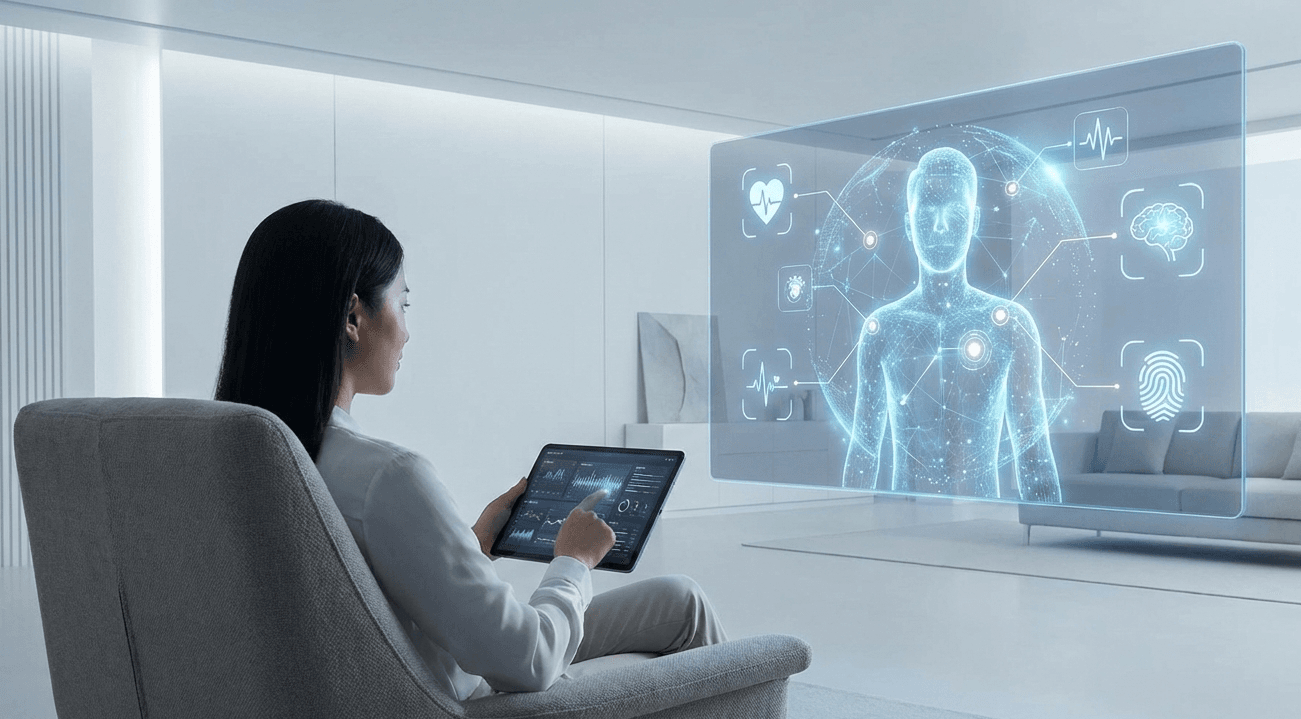
The digital twin concept in industrial engineering is relatively well-understood: a virtual model of a physical object or system that updates in real time based on sensor data from the real counterpart, allowing engineers to simulate changes, predict failures, and optimise performance without touching the physical thing. The idea of applying this to human bodies — creating a digital twin that mirrors your biometric reality and allows simulation of health interventions before they’re applied to you — sits somewhere between a compelling scientific frontier and an uncomfortable data ethics question.
Both the excitement and the discomfort are worth taking seriously, because biometric digital twins are moving from conceptual framework to technical reality faster than the governance frameworks around them are developing.
What a Biometric Digital Twin Actually Is
A biometric digital twin is a continuously updated computational model of an individual’s physiology. At its simplest level, a fitness wearable that tracks your heart rate, sleep, and activity and uses that data to make personalised predictions about your health is a primitive version — a digital model that reflects your physical state and improves its predictions over time. What researchers and technologists are working toward is considerably more sophisticated: a multi-system model that integrates cardiovascular, metabolic, neurological, and immune system data to create a simulation that can predict how your specific body will respond to specific interventions.
The genome sequencing piece has been available for years. What’s new is the ability to integrate genomic data with real-time physiological monitoring, clinical history, and increasingly, microbiome profiling, to create models with genuine predictive granularity. A biometric digital twin, at the state of the art, doesn’t just know that you’re 42 and have elevated cholesterol — it knows your specific genetic variants affecting lipid metabolism, your microbiome’s composition and how it processes dietary fats, your circadian patterns, your inflammatory baseline, and your historical response to exercise and dietary interventions.
The Clinical Applications
Personalised medicine has been a promise for decades. The biometric digital twin is one of the frameworks through which that promise is beginning to be operationalised. Rather than prescribing the standard first-line medication for a condition and waiting to see if it works, a sufficiently detailed biometric model allows clinicians to simulate the likely response to different interventions before applying them. This is already happening in research settings for cancer treatment planning, where tumour genomic models are used to predict drug response, and the direction of expansion into broader medicine is clear.
Preventive medicine is another compelling application. A digital twin that accurately models your cardiovascular risk factors in real time can identify the trajectory of risk accumulation years before a clinical event occurs, allowing intervention at a point when it’s most effective. The difference between a standard annual health check — a snapshot at one point in time — and a continuously updated model of your physiological state is the difference between a photograph and a live video feed.
The Data Question
A useful biometric digital twin requires an enormous amount of deeply personal data. Genomic information, detailed physiological monitoring, health history, behavioural patterns — the combination creates a level of insight into an individual that raises legitimate questions about ownership, access, and potential misuse that current regulatory frameworks are only beginning to address.
Who owns your biometric twin? Can insurance companies access the predictions it generates about your future health risk? Can employers? What happens to the data when the company that hosts it is acquired? The technical development of biometric digital twins is significantly ahead of the legal and ethical frameworks designed to govern them. That gap is not a reason to stop the technology, but it is a reason for people engaging with it to be thoughtful about what data they share, with whom, and under what terms.
The technology itself — the ability to model your own physiology and use that model to make better decisions about your health — represents one of the most significant potential advances in personalised medicine in a generation. The governance of that technology will determine whether its benefits are broadly shared or captured by actors whose interests don’t align with the people whose bodies are being modelled.