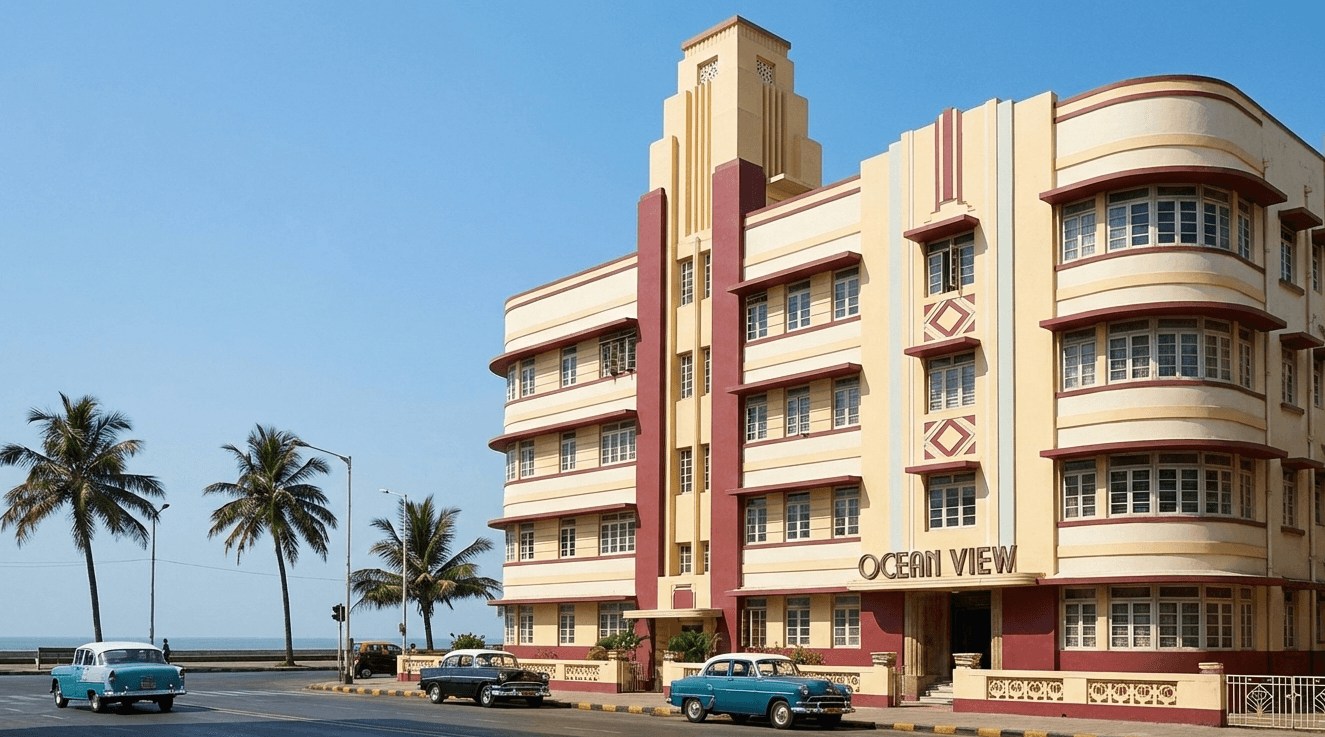
I arrived in Mumbai with the usual agenda — the Gateway of India, Colaba market, a seafood lunch at a restaurant someone had recommended with the certainty of the recently converted. What I hadn’t expected was to spend three hours on an afternoon walking slowly through a district that stopped me mid-step every hundred metres. The buildings along Marine Drive and in the Oval Maidan precinct are unlike anything else I’ve seen in the world — not because they’re the grandest Art Deco structures, but because of their density, their specific colour (that distinctive cream and buff, bleached by decades of salt air and monsoon), and the way they sit in a city that has grown enormously around them without quite swallowing them.
Mumbai’s Art Deco heritage is one of the most significant concentrations of Art Deco architecture outside Miami Beach, and arguably more historically interesting. The buildings in South Mumbai were constructed primarily between the 1930s and 1950s, during the late colonial period and the years immediately following Indian independence. They were built for a Bombay that was confident, cosmopolitan, and economically significant — a city conscious of its place in the world and building accordingly. The resulting architecture is a distinctive hybrid: Art Deco forms and motifs adapted by Indian architects for an Indian climate and social context, producing something that is identifiably Deco and identifiably Bombay simultaneously.
The Architecture of the Oval Maidan
The Oval Maidan precinct is where Art Deco density is most concentrated and most spectacular. The buildings lining the eastern edge of this cricket ground — central to Bombay’s civic life since the mid-nineteenth century — form one of the most coherent Art Deco streetscapes anywhere in the world. Building after building presents the characteristic features: stepped facades, geometric ornamentation, cantilevered balconies with decorative railings, horizontal banding, and sunburst and chevron motifs, here adapted with Indian elements — lotus patterns, figurative reliefs inspired by Hindu and Buddhist iconography, peacock motifs.
The Eros Cinema on Churchgate Street, opened in 1938 and designed by Sorabji Bhedwar, is the building most architecture historians cite as the exemplar of Bombay’s distinctive Deco style. The facade’s curved corner entrance tower, the geometric detailing in the stonework, and the way the building holds its corner without dominating or retreating from the street are all characteristic of the style at its most accomplished. It is still operating as a cinema — genuinely still showing films — which adds a poignancy that a museum-ified heritage building couldn’t replicate.
The Social History in the Buildings
The Art Deco apartment buildings of South Mumbai were designed for the professional and commercial middle class of a prosperous colonial city — lawyers, doctors, merchants, civil servants. The apartments were intended to be modern in the ways that mattered to this class: cross-ventilated for the Mumbai climate (the deep balconies and building orientations were not merely aesthetic but functional), fitted with modern plumbing and electrical infrastructure, and organised around communal spaces reflecting a particular vision of urban life. The World Monuments Fund and UNESCO have both been involved in conservation work in the precinct. The buildings face the pressures heritage architecture faces everywhere: maintenance economics, competing interests of residents and developers, and the difficulty of preserving social fabric alongside physical fabric. Walking through the precinct today, you see buildings in various states — some meticulously maintained, some faded, some mid-renovation. The whole is extraordinary regardless. Find a quiet afternoon, walk slowly, and look up.

One thought on “Bombay Art Deco: A Practical Guide to Mumbai’s Heritage”