⚕️ Medical note: This article is for informational purposes. Digestive symptoms should be evaluated by a qualified clinician rather than self-managed solely through dietary timing.
I used to eat dinner at nine or ten o’clock at night, because that was when I got home from work and that was when I cooked. I thought of this as a neutral fact about my schedule rather than something with health implications. Then I came across research on chrono-nutrition and realised that the timing of my meals was actively working against my body’s metabolic preferences. That realisation didn’t immediately change my schedule — London doesn’t really do six o’clock dinners — but it changed how I thought about the food decisions I could control.
Chrono-nutrition is the study of how meal timing interacts with our circadian biology to affect health. It sits at the intersection of chronobiology (the science of biological timekeeping), nutritional science, and gut microbiome research, and in the last decade it has generated enough evidence to warrant taking seriously, even as the mainstream health conversation has been slow to catch up.
Your Gut Has Its Own Clock
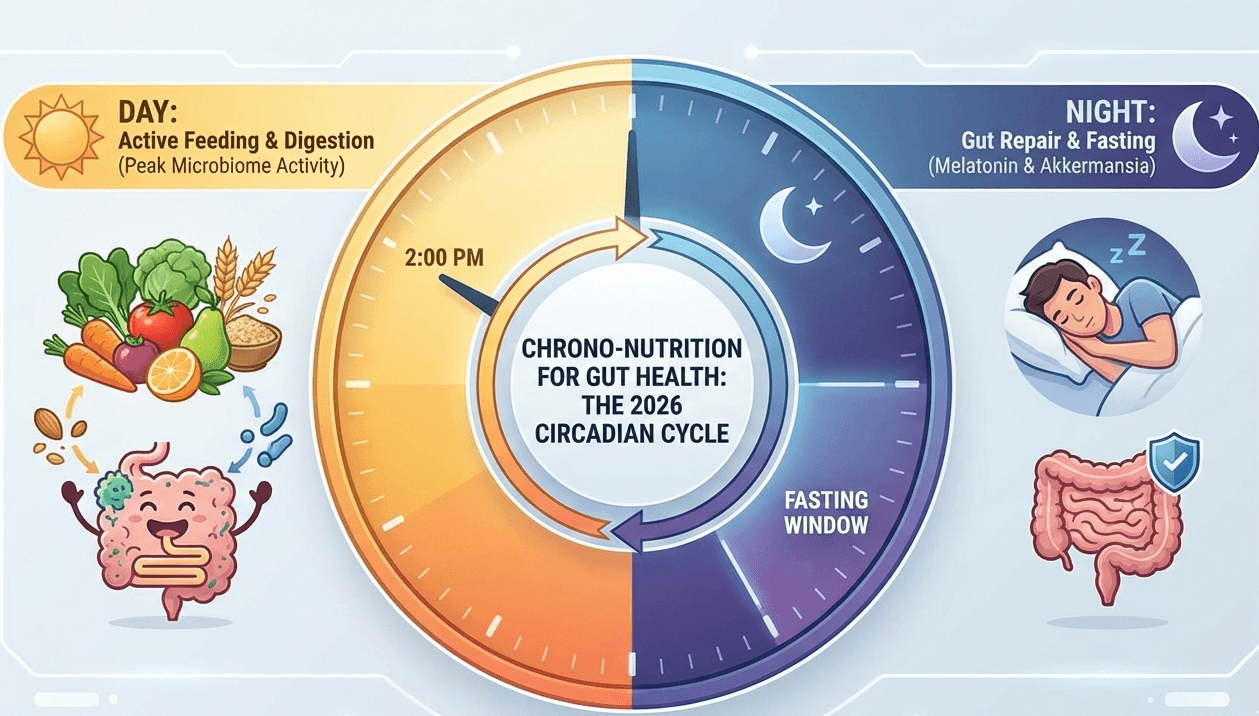
The gut microbiome — the community of trillions of microorganisms that live in the digestive tract — has a circadian rhythm. Research from the Weizmann Institute in Israel and the Salk Institute in the US has demonstrated that specific bacterial populations in the gut oscillate across the day, peaking at different times and performing different functions depending on where they are in their cycle. The bacteria that are most active in the morning differ from those most active at night. These shifts are partly driven by the light-dark cycle via the brain’s master clock, and partly entrained directly by meal timing.
When meal timing is inconsistent — eating at different times each day — or chronically misaligned with the light-dark cycle — eating large meals late at night — the microbiome’s own rhythms become disrupted. This dysregulation is associated with reduced microbial diversity, increased gut permeability, and worse metabolic outcomes. A 2023 study in Cell Host & Microbe found that even a two-hour daily shift in meal timing over just four weeks measurably altered microbiome composition in healthy adults.
What the Research Says About Optimal Timing
Insulin sensitivity — the efficiency with which your cells respond to insulin and take up glucose from the blood — is higher in the morning than in the evening. This means that the same carbohydrate-heavy meal will produce a more moderate blood glucose response at 8am than at 8pm. The practical implication is that eating more of your daily carbohydrates earlier in the day is metabolically more efficient, regardless of total caloric intake.
Digestive enzymes and gut motility also follow circadian patterns. Gastric acid secretion peaks in the early evening, which may be why many people feel genuinely hungry at dinner time — but the downstream processing of that meal, particularly glucose metabolism, is less efficient at that hour than earlier in the day. The gut is not as adept at managing a large bolus of food at 10pm as it would be at midday.
The most consistent finding across chrono-nutrition research is that front-loading caloric intake — eating more earlier in the day and less later — improves markers of metabolic health including waist circumference, blood glucose, blood pressure, and inflammatory markers. A landmark trial by Jakubowicz et al. compared two groups eating identical foods in equal total calories: one group with a large breakfast and small dinner, one with the reverse. The large-breakfast group lost more weight, had lower post-meal glucose responses, and reported less hunger. The only variable was timing.
What About Gut Symptoms Specifically
For people who experience digestive discomfort — bloating, irregular motility, IBS-type symptoms — meal timing is one of several modifiable factors worth paying attention to. Late meals before sleep reduce the window for gastric emptying, which can exacerbate reflux and bloating. Eating at consistent times each day appears to improve gut motility regularity, probably because it helps synchronise the microbiome’s rhythms and the enteric nervous system’s coordinated functions.
There’s also emerging evidence that fasting windows — the period between the last meal of the day and the first of the next morning — support gut repair processes. The small intestine undergoes active maintenance during fasting, including clearance of cellular debris. Short overnight fasting windows of twelve to fourteen hours appear to support this process, though the evidence is still partly extrapolated from animal research.
Practical Takeaways That Are Actually Usable
You don’t need to overhaul your entire eating schedule. Three evidence-grounded changes are achievable for most people. First, make breakfast a proper meal rather than a coffee. The morning is the most metabolically efficient time to eat, and skipping it doesn’t get the metabolic benefit people assume — it just moves the caloric load to a less efficient time of day. Second, avoid large meals within two hours of sleeping. This is the single easiest change for most people and has clear evidence behind it. Third, try to eat at consistent times each day. Your microbiome benefits from regularity, and consistency appears to be more important than optimisation of timing in absolute terms.
Chrono-nutrition doesn’t require expensive supplements, specific diets, or dramatic lifestyle changes. It requires paying attention to when you eat as well as what you eat. That adjustment is free, accessible, and supported by an increasingly solid body of evidence.



One thought on “Chrono-Nutrition for Gut Health: Optimize Your Metabolic Rhythm”