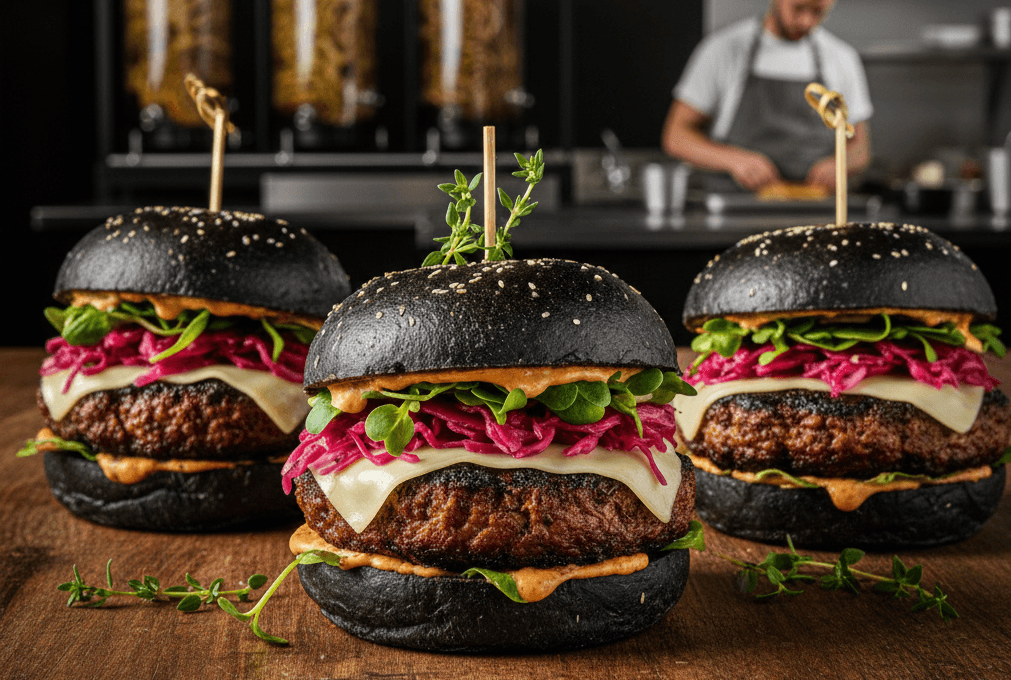
I was sceptical about mushroom smash burgers for longer than I should have been. The words “mushroom” and “burger” have been awkwardly paired in vegetarian cooking for decades, usually producing something that’s neither quite a mushroom dish nor quite a burger — a polite compromise with textures that apologise for themselves. When a friend made me one using king oyster mushrooms, a screaming-hot cast iron pan, and an actual smashing technique, I revised my opinion immediately. It tasted nothing like the mushroom-patty substitute I’d been imagining. It tasted like something genuinely worth making again the following week.
The key isn’t the mushroom itself — it’s the method. Smashing creates an enormous amount of surface contact with a hot pan, which drives the Maillard reaction (the browning chemistry that produces flavour) across a wide, thin surface. King oyster mushroom stems, when smashed flat and cooked hard, develop a texture and depth of flavour that operates completely differently from a roasted portobello or a sautéed button mushroom. Add the adaptogenic element — specific functional mushrooms with wellness properties currently under investigation — and you have a dish that sits interestingly at the intersection of serious cooking and the current functional food moment.
The Adaptogenic Angle
Adaptogens are compounds, most commonly from plants or fungi, proposed to help the body manage physical, chemical, and biological stress. The most studied fungal adaptogens are lion’s mane (associated with nerve growth factor support and cognitive function in preliminary research), reishi (associated with immune modulation), and chaga (associated with antioxidant activity). The research is genuinely interesting and genuinely early — most substantive human trial evidence is limited in scale and the mechanisms are not fully understood. But the direction is real enough to be worth paying attention to.
For a burger recipe, the most practical application isn’t using reishi as a structural ingredient — its woody texture doesn’t lend itself to smashing — but adding lion’s mane alongside king oyster for its texture (it shreds beautifully and crisps well) or incorporating mushroom powder blends as a seasoning component. The flavour contribution is earthy and umami-rich; the purported functional benefit is a bonus rather than the point.
How to Actually Make These
Technique matters more than mushroom variety, though king oyster gives the best structural result. Take large king oyster mushrooms and slice the stems into rounds about two centimetres thick. Heat a cast iron skillet until genuinely, aggressively hot — this is not a medium-heat situation. Add a neutral oil with a high smoke point (avocado or refined sunflower work well). Place the mushroom rounds in the pan and immediately smash them flat with a heavy spatula, applying sustained pressure for about ten seconds. You want them thin.
Leave them completely undisturbed for two to three minutes. The crust needs to form, and it won’t if you nudge them. When they release easily and the underside is deep golden-brown to almost charred at the edges, flip and repeat. Season aggressively with salt — mushrooms absorb it and need more than you expect.
Accompaniments are where this dish becomes genuinely good: white miso butter (softened butter beaten with white miso 3:1) on a toasted brioche bun, quick-pickled red onion for acidity, and a spoonful of gochujang mayo. The flavour profile — deep umami, fat, acid, heat — is precisely what a good smash burger delivers, and the mushroom base carries it without apology. Make it once with a properly hot pan and the patience to leave it alone, and you’ll understand the enthusiasm.
2 thoughts on “Mushroom Smash Burgers: A Recipe Worth Making Tonight”