What Exactly Defines a Wide-Hip, Short-Torso Body Proportion?
A wide-hip, short-torso proportion describes a figure where the distance from shoulder to natural waist is notably shorter than average, while the hip measurement exceeds the shoulder measurement by two or more inches. This configuration — often described as a pear or bell silhouette — means the natural waist sits high and the hip curve begins earlier. Recognizing this precisely is the first step toward strategic dressing.
Most styling guides conflate this shape with a standard pear body type and leave it there. That misses the critical detail: a short torso changes everything about where waistbands, hemlines, and necklines land relative to your proportions. The goal of summer dressing for this body proportion is not to minimize or hide anything. It is to create visual balance — extending the appearance of the upper body, softening the hip line, and working with fabric and silhouette to achieve harmony.
According to reporting by Business of Fashion and the annual McKinsey State of Fashion survey, hyper-personalized styling intelligence is now among the top three consumer demands in apparel, with 84% of organizations prioritizing individualized guidance across customer touchpoints. Body-proportion dressing sits at the center of that shift.
Which Summer Silhouettes Work Best for a Short Torso and Wide Hips?
The most effective summer silhouettes for this proportion are the wrap dress, the A-line midi, the empire-waist style, and the wide-leg trouser paired with a puff-sleeve or structured top. Each of these works by one of two mechanisms: lengthening the torso visually, or redirecting the eye upward and outward past the hips. Avoid anything that terminates at the widest hip point.
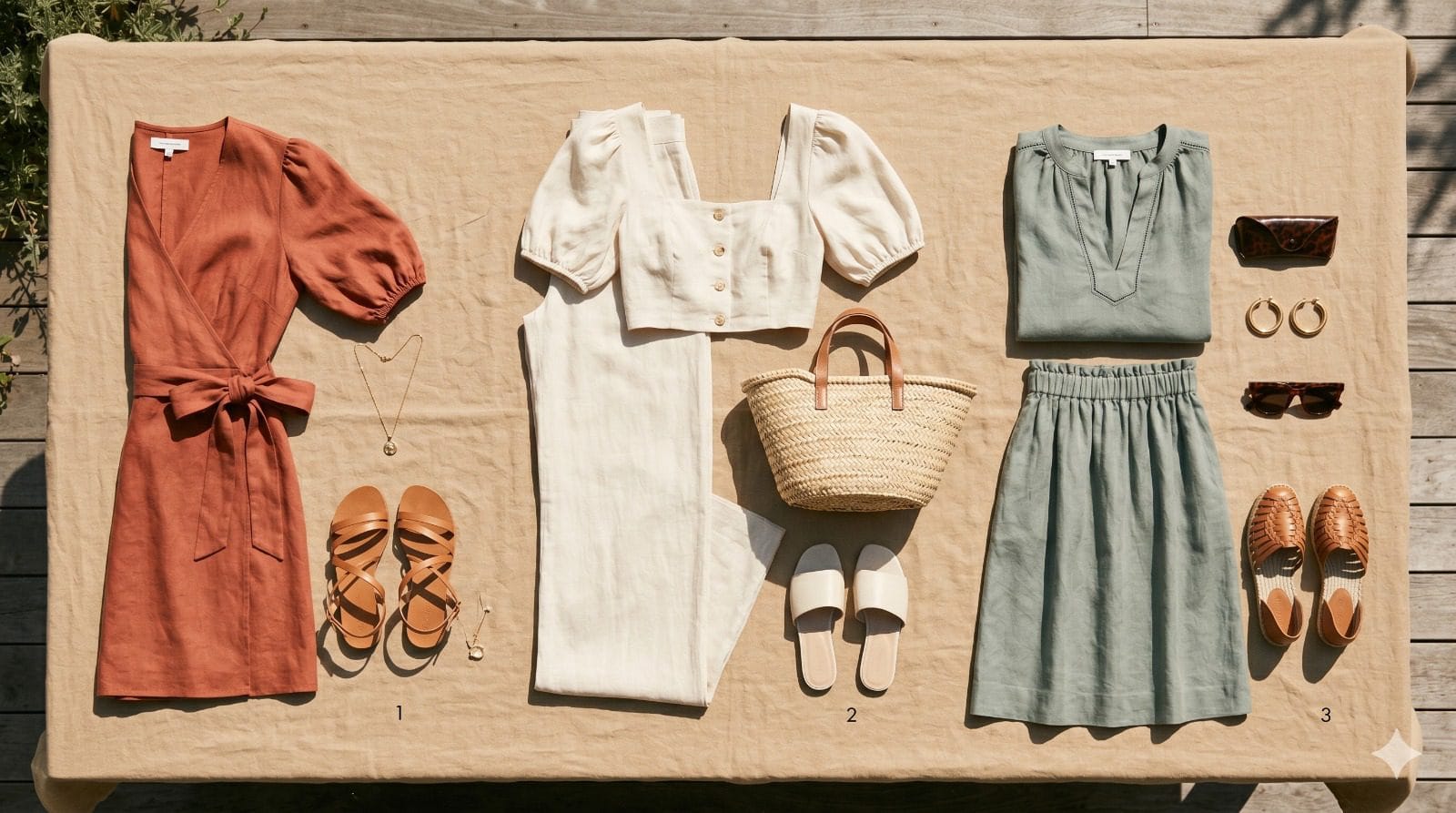
The wrap dress earns its permanent position in this body type’s wardrobe because it does two things simultaneously. The diagonal neckline draws the eye up and across the upper body, while the skirt flares away from the hip rather than clinging to it. Reformation’s wrap offerings — consistently cut with a defined bust point and fluid skirt — demonstrate how runway-to-retail translation can serve this proportion with commercial precision.
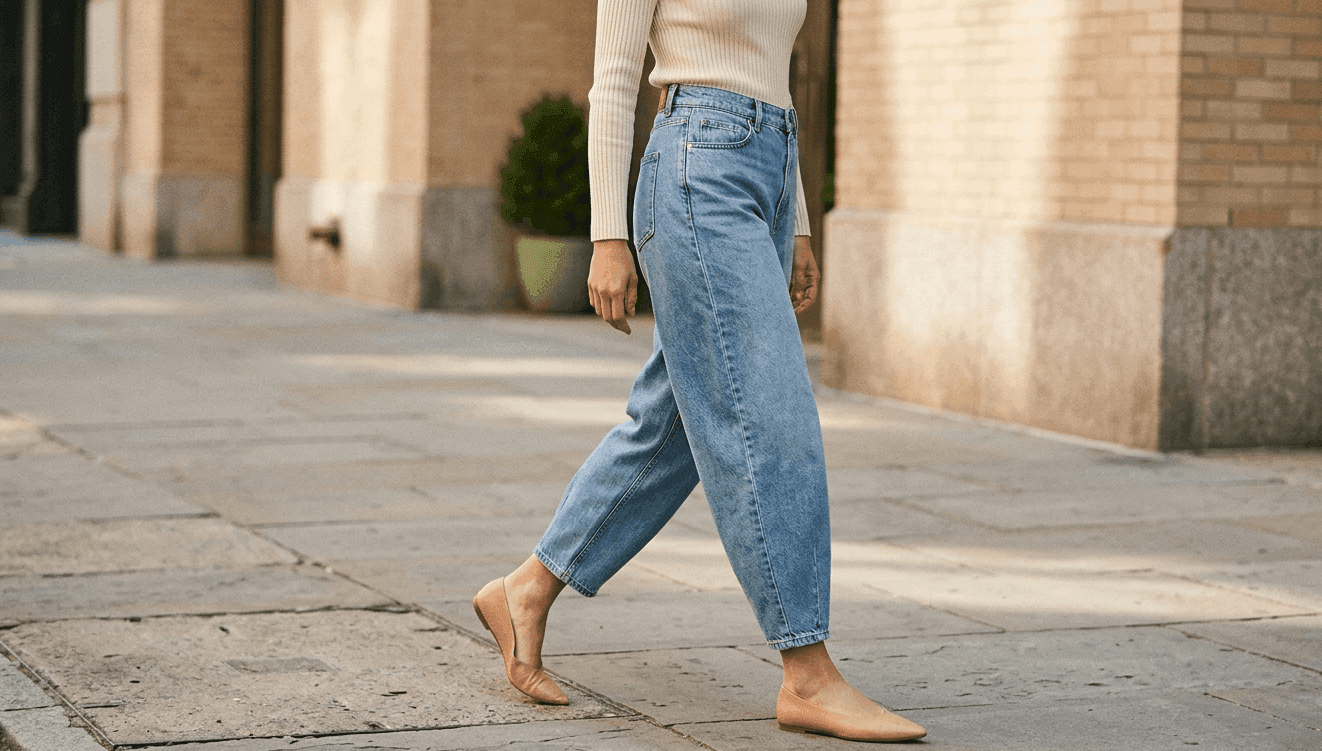
For separates, the equation is straightforward: a V-neck or square-neck top with a fitted but not tight bodice, worn either half-tucked or ending at the hip bone, paired with wide-leg linen trousers in a dark, clean colorway. The wide leg creates a counterweight to the hip width. It does not minimize the hip; it balances the full silhouette from shoulder to hem. Good American and Everlane Curvy have built consistent sell-through on exactly this formula.
How Do You Visually Lengthen a Short Torso in Summer Outfits?
Lengthening a short torso in summer relies on three tools: neckline choice, vertical detailing, and strategic color placement. A V-neck or deep square neckline creates a vertical line from collarbone downward, adding perceived length. Vertical seaming, button plackets, or fine stripe patterns on tops reinforce that downward direction. Keeping the top and bottom in the same tonal family — a monochromatic or tonal colorway — removes the visual break at the waist and lets the eye travel the full length of the body.
Avoid wide, contrasting waistbands. A bold elastic band in a different color marks the waist precisely where you do not want attention. If you choose a belt, keep it in the same color as your top, not your bottom. This extends the torso’s perceived height rather than cutting it short. The Carol Tuttle body-type framework popularized the rope or loose hanging belt specifically for this reason — it carries the eye downward rather than anchoring it at the shortest point of the torso.
Long pendant necklaces function as portable vertical lines. Stitch Fix’s stylists have consistently cited them as among the most underused accessories for short-torso proportion dressing. A 28-to-32-inch gold chain worn over an open neckline extends the neck-to-waist visual distance measurably.
What Bottoms Should You Choose for Wide Hips This Summer?
For wide hips in summer, prioritize mid-rise to high-rise wide-leg trousers, A-line midi skirts, and bias-cut maxi skirts in lightweight, breathable fabrications. Mid-rise is preferable to ultra-high-rise for a short torso specifically — a waistband that reaches above the navel can make the torso appear even shorter by crowding the upper body. The sweet spot is a rise that sits comfortably at or just above the hip bone.
Linen and Tencel are the dominant fabric choices here for functional and ethical reasons. Both drape cleanly away from the hip rather than clinging, and both perform well in warm climates. The Ellen MacArthur Foundation’s circular economy framework identifies linen — derived from the flax plant — as one of the lower-impact warm-weather fabrics available in mainstream retail. Tencel, produced from sustainably sourced wood pulp via closed-loop processing, carries verification from the Global Organic Textile Standard and is increasingly available at mid-market price points from brands like Everlane and Thought Clothing.
Dark colorways on the bottom remain one of the most practical optical tools available. A deep navy, rich olive, or clean black bottom visually recedes, reducing the perceived width of the hip. Pair that with a lighter or brighter top and the eye travels upward by default.
Are There Specific Dress Styles That Flatter Both a Short Torso and Wide Hips?
Yes — the wrap dress, the A-line shirt dress belted at the waist, and the empire-line maxi are the three most consistently flattering dress styles for this combination. Each creates a defined waist point, flares through the skirt, and avoids clinging across the hip and thigh. The shift dress works too, but only in structured fabrications; in fluid jersey, it risks emphasizing the widest point without providing counterbalance.
The drop-waist silhouette — revived periodically from its 1920s flapper origins — deserves more credit than it receives for this proportion. It fits loosely from shoulder to hip, then transitions to a gathered or pleated skirt, effectively pushing the visual waistline downward and adding perceived length to the torso. In summer-weight cotton or linen, it becomes both practical and proportionally elegant. [See WGSN’s Summer 2026 womenswear trend report for drop-waist revival data across mid-market RTW.]
The empire-line maxi — a silhouette that gathers just below the bust and falls straight to the floor — works by anchoring all attention at the upper chest, well above the natural waist. For warm-weather events, it is the most effortless single-piece solution available.
How Does Sustainable Fashion Intersect With Body-Proportion Dressing in 2025?
The slow fashion movement and body-inclusive dressing are arriving at the same consumer at the same moment. Value-conscious shoppers — a dominant force in 2025 according to McKinsey’s State of Fashion 2026 report — are simultaneously demanding clothes that fit their actual bodies and last beyond one season. The 10-item capsule method offers a structural answer: build a small, versatile wardrobe of silhouettes that perform reliably for your specific proportion, rather than chasing trend cycles that are not designed with your body in mind.
Brands like Reformation, Thought Clothing, and Madewell Curvy have moved furthest toward combining size-inclusive design with lower-impact fabrication. Savage X Fenty set the industry benchmark for broadening the range of bodies presented as aspirational. The British Fashion Council has identified inclusive sizing and transparent supply chains as twin imperatives for the industry’s next phase.
Dressing intentionally for your proportion is, in itself, a sustainable act. Buying fewer pieces that fit correctly and work across multiple occasions reduces return rates, extends garment life, and diminishes the throughput that feeds the fast-fashion cycle. That framework — style intelligence as environmental intelligence — is where proportion dressing and conscious consumption finally converge.