Sometime in mid-2024, I noticed something that quietly changed how I thought about content strategy.
A client site was ranking consistently on page one for several competitive keywords. Traffic was stable. By every traditional SEO metric, the site was performing well. But a growing percentage of users searching for the exact topics we covered were never seeing the site at all — because they were getting their answers from AI-generated summaries in ChatGPT, Perplexity, Google’s AI Mode, and Bing Copilot without ever reaching the search results page.
The content existed. It was well-optimised. And it was being systematically bypassed.
That was the moment I started taking Generative Engine Optimization seriously — not as a trend to track, but as a strategic shift that was already underway whether I engaged with it or not.
What Is Generative Engine Optimization and Why Does It Matter Now?
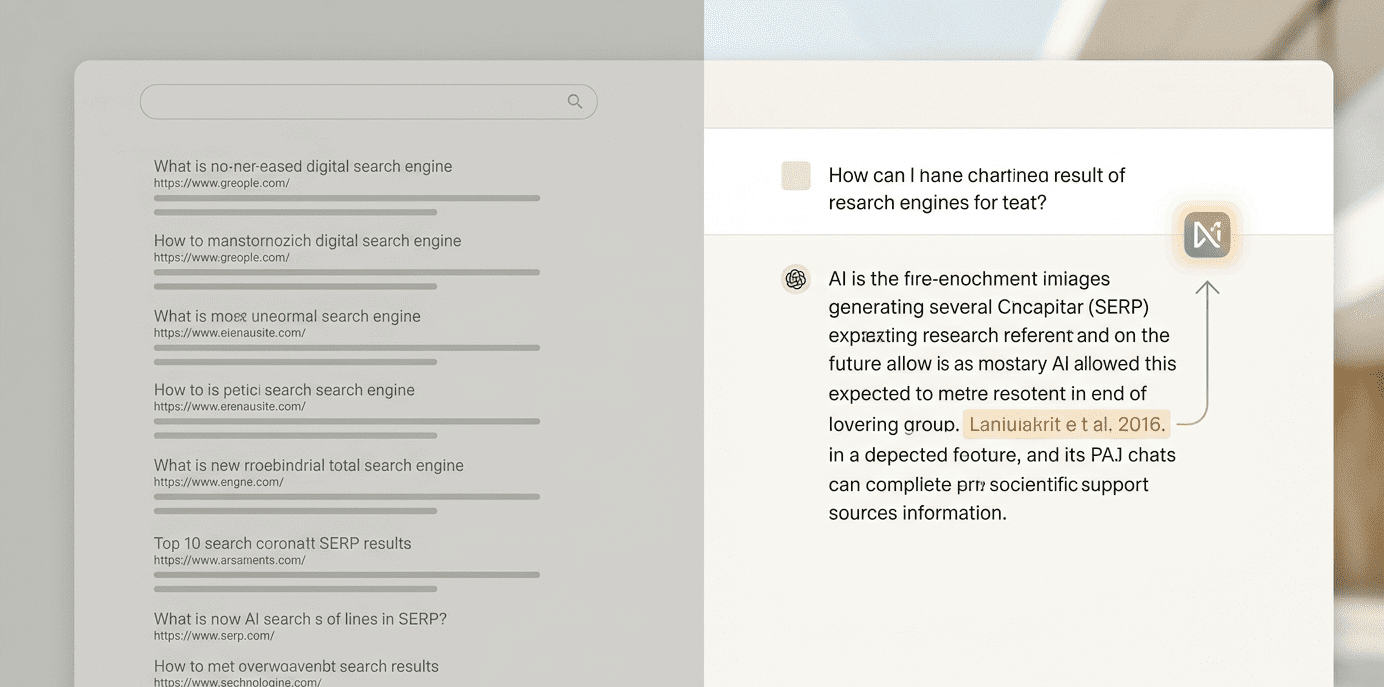
Generative Engine Optimization (GEO) is the discipline of structuring and optimizing content so that AI search systems — including ChatGPT, Perplexity, Google AI Overviews, and Gemini — select, cite, and attribute your content in their generated answers. Unlike SEO, which competes for ranked links, GEO competes for citation inside the answer itself.
Generative Engine Optimization is the practice of creating and structuring content so it gets cited, referenced, or recommended by AI systems — including ChatGPT, Perplexity, Google AI Mode, Microsoft Copilot, and similar tools — rather than optimising exclusively for traditional search engine rankings.
Where traditional SEO focused on signals like backlinks, keyword placement, and page authority to rank in a list of blue links, GEO focuses on content characteristics that make AI systems trust, extract, and surface your material in generated responses.
The distinction matters because the mechanism is different. A search engine ranks pages. An AI system synthesises answers. To rank well, you needed authority signals. To get cited in an AI response, you need clarity, specificity, and demonstrable credibility at the content level — independent of how many other sites link to you.
How big is the shift from search to AI-generated answers?
Bigger than most publishers have fully absorbed.
Salesforce’s State of the Connected Customer report found that 41% of consumers already prefer using AI assistants for information retrieval over traditional search engines. A BrightEdge study from late 2024 found that AI Overviews now appear in over 30% of all Google searches — a figure that has continued rising into 2025.
More significantly, zero-click searches — where users get an answer without visiting any website — have increased sharply since AI-generated answers became mainstream. SparkToro’s 2024 analysis estimated that nearly 60% of Google searches in the US and EU already end without a click. As AI-generated answers improve, that number is likely to rise further.
For content-dependent businesses — publishers, bloggers, media sites, and B2B content operations — this is not a future threat to monitor. It’s a present reality to respond to.
How is GEO different from traditional SEO in practice?
Traditional SEO was largely about signals external to the content itself: how many sites linked to you, how old your domain was, how fast your page loaded, whether you had the right keywords in the right density. The content mattered, but it was one factor among many.
GEO is almost entirely about the content itself — specifically, whether the content gives an AI system enough to work with to construct a confident, accurate response.
AI systems evaluate content along several dimensions that differ from traditional ranking signals. Factual specificity matters more than keyword presence. Named sources and cited research carry more weight than general assertions. Direct, complete answers to specific questions are more extractable than discursive prose that works toward an answer gradually. And consistency of expertise across a site — what Google calls topical authority — signals to AI systems that a source can be trusted on a given subject.
The shift also changes what “winning” looks like. In traditional SEO, the goal was position one on page one. In GEO, the goal is being the source an AI cites when someone asks a question in your space — which may or may not correlate with your traditional search ranking.
What content characteristics get cited by AI systems?
This is where the practical work of GEO happens, and where most published guidance is too vague to be useful.
Based on analysis of content that consistently gets cited across Perplexity, ChatGPT with browsing, and Google’s AI Mode, several characteristics emerge repeatedly.
Specific, attributed claims perform better than general ones. “A 2024 McKinsey report found that 65% of organisations had adopted AI in at least one business function” is more citable than “many organisations are adopting AI.” The specificity gives the AI system something concrete to extract and attribute.
First-hand expertise signals matter. Content that demonstrates the author has direct experience with the topic — not just research knowledge — gets treated differently than aggregated third-party information. This connects to Google’s E-E-A-T framework (Experience, Expertise, Authoritativeness, Trustworthiness), which AI systems appear to use as a proxy for source quality.
Comprehensive coverage of a topic from a single trusted source reduces the AI system’s need to synthesise across multiple sites — which increases the chance your content becomes the primary citation rather than one of several partial references.
Structured content — clear headers, defined terms, numbered processes, comparison tables — is more extractable than continuous prose because it maps more cleanly onto the format AI systems use to generate structured responses.
Does GEO mean abandoning traditional SEO?
No — and this is one of the most common misunderstandings in how this topic gets covered.
Traditional search traffic is not disappearing. It’s redistributing. Users with complex, specific, or transactional needs still click through to websites. Users with simple informational needs increasingly get their answer without clicking. The profile of who reaches your site through organic search is shifting, not the channel itself.
The most effective approach treats GEO and traditional SEO as parallel rather than competing strategies. Optimising for traditional ranking signals — technical health, backlink authority, page experience — remains valuable for maintaining visibility in search results. Optimising for GEO — content depth, factual specificity, structural clarity, demonstrated expertise — increases citation likelihood in AI-generated answers.
Critically, the content improvements GEO requires tend to improve traditional SEO performance as well. Clearer structure, more specific claims, better cited sources, and more demonstrable expertise all signal quality to Google’s traditional ranking algorithm alongside its AI systems. GEO optimisation rarely hurts SEO. It usually helps it.
What’s the single most important change a content team can make for GEO?
Stop writing for search volume and start writing for question completeness.
Traditional content strategy optimised for search volume — find the keywords people search for and write content around them. GEO strategy optimises for question resolution — identify the specific questions your audience asks and write content that fully answers each one, with named sources, specific data, and a clear structure that allows an AI to extract the answer cleanly.
This means fewer, longer, more comprehensive pieces rather than many shorter pieces targeting keyword variations. It means citing primary research and named studies rather than linking to secondary aggregators. It means writing author bios that establish genuine credentials rather than placeholder descriptions.
For a rigorous academic treatment of how AI systems select sources for generated responses, Princeton University’s 2024 paper on generative engine optimization provides the most technically detailed publicly available analysis: arxiv.org/abs/2311.09735.



One thought on “Generative Engine Optimization: The 2026 Business Benchmark Report”
Comments are closed.