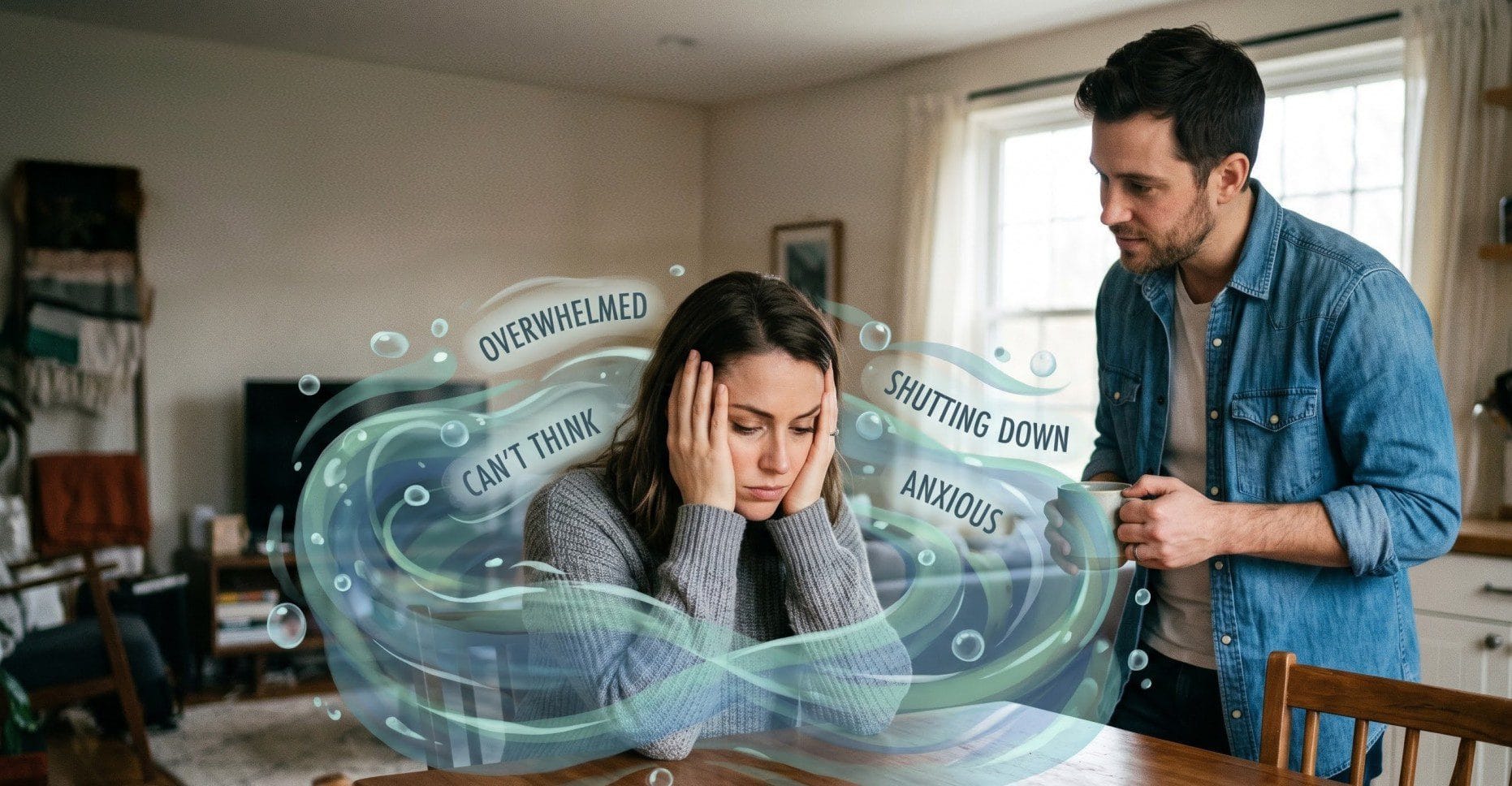
My worst argument with my husband lasted forty minutes. We were discussing something minor — whose turn it was to call the plumber. By minute ten, I couldn’t form a coherent sentence. By minute twenty, I’d said three things I genuinely didn’t mean. By minute forty, we’d both gone completely silent, sitting in separate rooms, unsure how something so small had turned into something so damaging.
It took me two years, a therapist, and a chapter in Dr. John Gottman’s The Seven Principles for Making Marriage Work to understand what had actually happened in that room.
I wasn’t being irrational. I wasn’t a bad communicator. I was emotionally flooded — and so was he — and once flooding starts, no amount of willpower or good intentions can undo what the nervous system has already decided.
What is emotional flooding and why does it happen?
Emotional flooding isn’t a problem that occurs at the emotional level. It happens on the physiological level, and is triggered by the amygdala — a section of the brain responsible for detecting threats – taking over the logical functioning center of the brain, also known as the prefrontal cortex. This causes an inability to think rationally and communicate effectively.
Emotional flooding is a physiological state, not just an emotional one. When your brain perceives a threat — whether that’s a genuine danger or a tense conversation with someone you love — the amygdala fires before the prefrontal cortex can respond. The amygdala is responsible for threat detection. The prefrontal cortex handles language, logic, and empathy. When the amygdala wins, rational communication becomes temporarily impossible.
Dr. John Gottman, whose research at the University of Washington tracked couples over decades, identified emotional flooding as one of the strongest predictors of relationship breakdown — not because flooded people are cruel, but because flooded people literally cannot access the communication skills they need. The brain is in survival mode. Nuance, tone, and careful word choice are casualties.
Heart rate is the clearest physiological marker. Gottman’s research found that when heart rate exceeds around 100 beats per minute during conflict, the body has entered a stress state that makes productive conversation functionally impossible. You may still be speaking. But you’re no longer truly communicating.
How do you know if you’re flooded versus just overwhelmed?
This distinction matters because the two states need different responses.
Being overwhelmed means you’re stretched — irritated, stressed, carrying too much. You can still form sentences. You can still hear what the other person is saying, even if you’re not responding at your best. Overwhelmed people benefit from slowing down, taking a breath, asking for a moment.
Being flooded is categorically different. Your heart is pounding. Your thoughts are either racing or completely blank. You hear words but can’t process their meaning. You’re either shutting down entirely or on the edge of saying something you’ll regret for days. Flooded people don’t benefit from pushing through — they need a genuine break for the nervous system to reset.
The clearest self-test: can you still hear what your partner is saying and respond to its actual content? If yes, you’re overwhelmed. If their words are landing but not registering — if you’re responding to the tone rather than the meaning — you’re flooded.
Why is emotional flooding becoming more common?
Post-pandemic life has raised baseline stress levels for most people in ways that haven’t been fully acknowledged. Hybrid work has blurred the boundary between professional stress and domestic space. Information overload keeps cortisol — the body’s primary stress hormone — chronically elevated in ways that adrenaline, which spikes and drops quickly, doesn’t.
That cortisol connection is important. Unlike adrenaline, which clears from the system within minutes, elevated cortisol persists for hours. It raises inflammation, disrupts sleep, increases anxiety, and — critically — lowers the flooding threshold. People who are chronically stressed get flooded faster, from smaller triggers, and take longer to recover.
This is why the same argument that felt manageable two years ago now escalates in minutes. The argument hasn’t changed. Your baseline stress level has.
What do you actually do when you feel flooding start?
Stop talking. This is the single most evidence-backed intervention available, and the one most people resist because stopping feels like losing.
Gottman’s research recommends a minimum twenty-minute break — not because twenty minutes is a magic number, but because that’s roughly how long it takes for cortisol and heart rate to return to a state where the prefrontal cortex can re-engage. A ten-minute break where you spend nine minutes mentally rehearsing your argument doesn’t count. The nervous system needs genuine disengagement.
Three things that actually work during that break: slow diaphragmatic breathing (inhale four seconds, hold four, exhale four, hold four — repeat five times), light physical movement like walking, and sensory grounding, where you deliberately name what you can see, hear, and touch to anchor yourself in the present rather than the argument.
What doesn’t work: replaying the argument, composing your response, or telling yourself to calm down without doing anything physiologically different. Thoughts don’t override a flooded nervous system. Physical regulation does.
How do you tell your partner you’re flooded without making it worse?
This is the piece most articles skip, and it’s genuinely the hardest part.
Saying “I need a break” in the middle of a conflict can land as stonewalling — a dismissal, a way of avoiding the conversation. The difference between a healthy pause and stonewalling is communication and a commitment to return.
Something like: “I can feel I’m getting flooded and I’m going to say something I don’t mean. Can we pause for twenty minutes and come back to this?” That sentence does three things: it names your internal state, it takes responsibility, and it makes a specific commitment. It’s not “I’m done talking.” It’s “I want to talk — I just need my brain to come back online first.”
After the break, don’t return to the argument immediately. Sit together quietly for a few minutes. Make brief physical contact if that’s natural for your relationship. Let both nervous systems settle before language re-enters the room.
What happens if flooding keeps repeating in a relationship?
Repeated flooding without proper recovery is cumulative. Each time you reach a flooding threshold and leave without genuine nervous system regulation — just time passing, not actual calming — your threshold drops a little lower. The next flood comes faster, from a smaller trigger.
Over time, this creates what Gottman calls “diffuse physiological arousal” — a state where both partners are chronically partially flooded, interpreting neutral interactions through a lens of threat. At that point the problem is no longer the argument. The problem is the relationship’s baseline stress level, which usually requires a therapist to address properly.
Flooding doesn’t just make individual arguments worse. Unaddressed, it erodes trust, emotional intimacy, and the felt safety that healthy relationships depend on. Addressing it early — learning to recognise it, name it, and respond to it correctly — is one of the highest-leverage investments a couple can make.
For a deeper understanding of Gottman’s flooding research and its relationship to long-term relationship outcomes, The Gottman Institute’s research library is the most comprehensive publicly available resource on evidence-based relationship science.