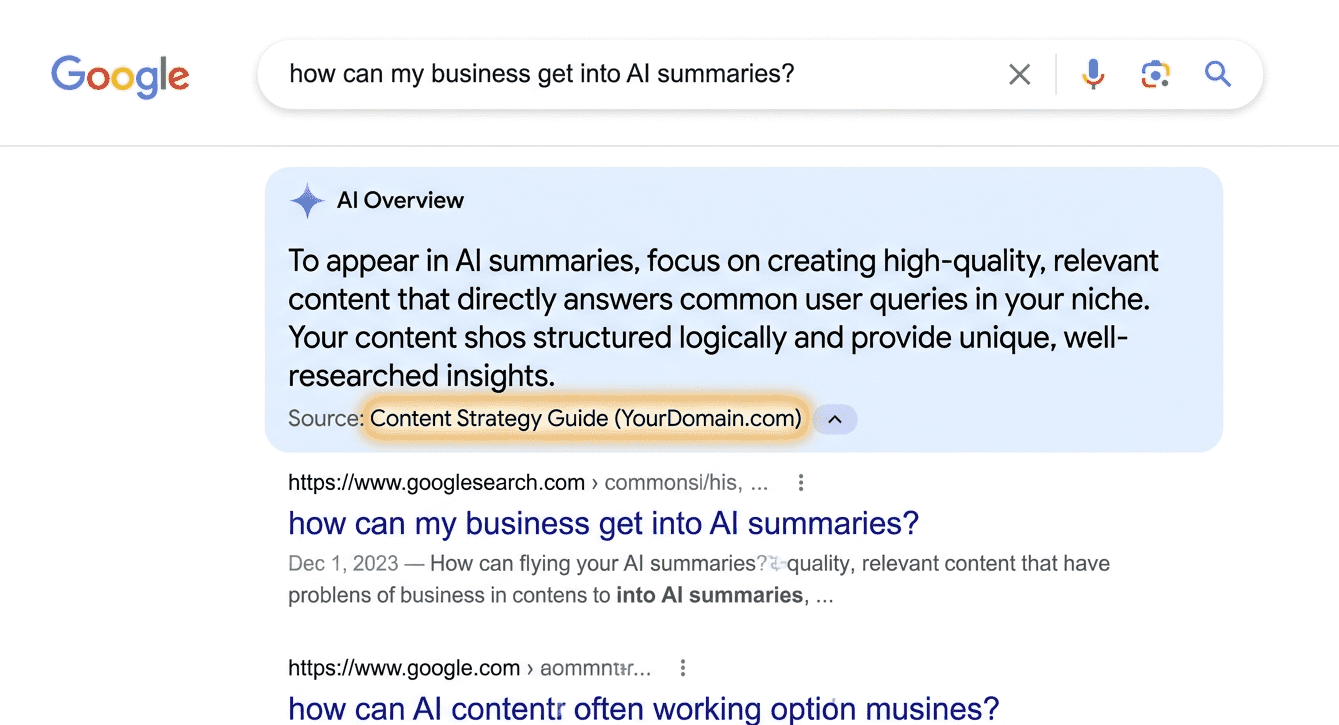
I manage content strategy across several publishing projects, and the shift I watched happen between early 2024 and late 2025 was the most disorienting thing I’ve seen in a decade of doing this work.
Traffic from Google didn’t disappear. It redistributed. Pages that had ranked steadily for two or three years held their positions but delivered fewer clicks. A new element sat above them — the AI Overview — pulling answers directly from content and presenting them without requiring the user to visit the source.
Some of my pages were cited in those overviews. Most weren’t. The difference between the ones that were and the ones that weren’t wasn’t domain authority or backlink count. It was something more structural about how the content was written.
This is what I learned figuring that out.
What Exactly Are Google AI Overviews and Why Do They Matter for SEO?
Google AI Overviews are AI-generated summaries powered by Google’s Gemini model that appear at the top of search results for informational queries. They synthesise content from multiple sources and cite them inline. As of Q1 2026, AI Overviews appear in 25–48% of all US searches, making citation inside them the most valuable form of organic visibility available.
A Google AI Overview is an AI-generated summary that appears at the top of certain search results pages, above the traditional blue links. It synthesises information from multiple sources across the web to provide a direct answer to a query, sometimes with citations shown alongside the summary.
Google’s AI Overviews use a combination of its search index and large language model capabilities to generate these summaries. The system identifies content it considers reliable, well-structured, and directly responsive to the query — then draws from it to compose the overview. Being cited doesn’t guarantee a click, but it places your content in front of users who would otherwise never visit your page at all.
As of 2025, AI Overviews appear most frequently for informational queries — how-to questions, definition requests, factual comparisons, and health or finance topics. They appear less frequently for navigational and transactional searches.
What makes content eligible to appear in an AI Overview?
Google has not published a definitive technical specification for AI Overview inclusion, but content that consistently gets cited shares identifiable characteristics.
Direct, specific answers to clear questions are the most consistent predictor. Content that states a complete, accurate answer within the first two to three sentences of a section — without burying it in preamble or qualification — is far more likely to be pulled into an overview than content that works up to the answer gradually.
Structural clarity matters too. Headers framed as questions signal to Google’s system what each section addresses. Short paragraphs that match the query intent precisely are more extractable than long, continuous prose. Tables, numbered steps, and defined terms perform especially well because they format information in ways that AI systems can parse and reuse easily.
Credibility signals — author credentials, links to primary sources, citations of named research or institutions — appear to increase inclusion likelihood for topics that fall into Google’s Your Money or Your Life (YMYL) categories, which include health, finance, legal, and safety content.
How is AI Overview optimisation different from traditional SEO?
Traditional SEO optimised primarily for ranking signals: backlinks, keyword density, page speed, mobile-friendliness, domain authority. These signals determined whether your page appeared in the top ten results.
AI Overview optimisation is about something different: extractability. Google’s AI doesn’t need your page to rank first to cite it. It needs your content to be the clearest, most directly useful answer to the query it’s trying to address — wherever your page sits in the index.
This changes the strategic priority. A page with moderate domain authority that answers a specific question in clear, well-structured prose can appear in an AI Overview above a page with stronger traditional SEO signals that buries its answer in long paragraphs.
The practical implication: for informational content, writing quality and structural clarity now matter as much as — and in some cases more than — link acquisition.
Does being cited in AI Overviews actually drive traffic?
Less than traditional ranking, but more than zero — and the benefit compounds in ways that aren’t immediately visible in traffic data.
Direct click-through from AI Overview citations is lower than from organic blue links, because the overview often answers the question without the user needing to visit the source. This is the zero-click problem that publishers have discussed since AI Overviews launched at scale.
The less-discussed benefit is brand visibility and topical authority. Users who see your site cited in an AI Overview repeatedly — even without clicking — develop familiarity with your name in connection with specific topics. That familiarity influences search behaviour over time. When the same user later searches for something more complex or transactional, they’re more likely to click on a name they’ve seen before in authoritative contexts.
There’s also an indexing signal benefit. Pages that get cited in AI Overviews tend to see improved treatment in Google’s broader index — likely because citation is itself an implicit quality signal that the system feeds back into ranking.
What specific content changes improve AI Overview citation chances?
Five structural changes produce measurable improvements based on the content experiments I’ve run across multiple sites.
Lead with the answer. The first sentence or two after a header should state the complete answer to the question the header poses. Context and qualification can follow, but the extractable answer needs to come first.
Use specific numbers and named sources. “Studies show” doesn’t help Google attribute confidence to a claim. “A 2024 Stanford study found” gives the system something concrete to evaluate and cite. Vague claims are less likely to be extracted than specific, attributed ones.
Write for the specific query, not the broad topic. A page optimised for “how to improve gut health” is competing with enormous content. A section precisely answering “does fermented food increase short-chain fatty acids” is far more extractable for that specific query.
Keep answer paragraphs short. Three to five sentences per idea. Longer paragraphs are harder for AI systems to extract cleanly without distorting the meaning.
Add a structured FAQ section. FAQ content is among the most consistently cited in AI Overviews — the question-answer format maps directly onto how the system is trying to generate summaries.
For the most current data on AI Overview behaviour and citation patterns, Search Engine Land’s AI Overviews coverage provides the most regularly updated analysis available from an independent search publication.
Is optimising for AI Overviews worth the effort in 2026?
Yes — but not because it immediately increases traffic. The value is strategic positioning during a transition that isn’t finished yet.
AI Overviews are still evolving rapidly. Google continues adjusting which queries trigger them, how citations are displayed, and what content qualifies for inclusion. Publishers who understand the underlying content principles — direct answers, structural clarity, credibility signals, specific attribution — are building for the version of Google that’s coming, not just the one that exists today.
The content habits that get you cited in AI Overviews are the same habits that produce genuinely useful, well-written content. That’s not a coincidence. It’s the point.