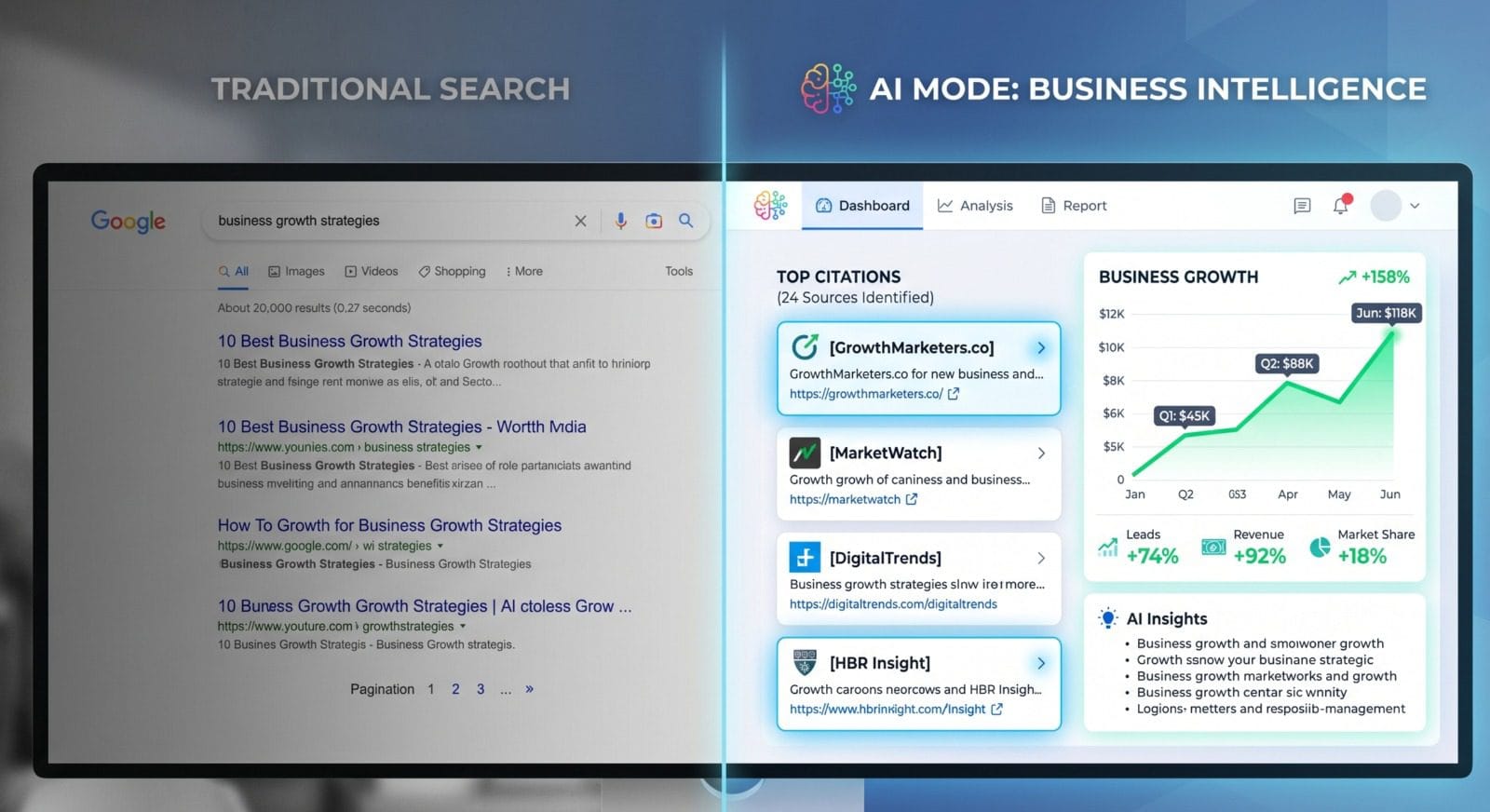
Google AI Mode just rewrote the rules of small business visibility. The companies getting cited in AI-generated answers are capturing traffic their competitors never see coming.
Most small business owners still think SEO means ranking on page one. That playbook died the moment Google began synthesizing answers instead of listing links. AI Overviews now reach 2 billion monthly users across more than 200 countries, marking the fastest adoption of any feature in Google’s history. Your competitors who adapt first will build citation authority you cannot catch. MarTech
The window for competitive advantage closes with every passing week. Businesses that optimize for AI Mode today establish brand mentions, topical authority, and trust signals that compound over months. Businesses that wait find themselves invisible in the search experience where most purchase decisions now begin.
This is not theoretical. Small businesses already report measurable traffic shifts. The companies positioned as authoritative sources inside AI-generated responses see conversion rates climb while traditional ranking-dependent businesses watch traffic erode. Your market position depends on understanding this transformation before your competition does.
What makes Google AI Mode different from regular search results?
Google AI Mode replaces blue-link result lists with synthesized answers that cite specific sources. Traditional search required users to click through multiple websites and piece together information themselves. AI Mode does that synthesis instantly, presenting one authoritative answer with embedded citations to trusted sources.
The mechanical difference matters for small business strategy. Regular search rewards ranking position. AI Mode rewards citation authority — being referenced as a source within the AI-generated response determines visibility, not where you rank below it. A business ranking seventh can earn more visibility than the number-one result if AI Mode cites them as the authoritative source. E2MDirect Online Marketing
This shift fundamentally changes competitive dynamics. Small businesses with deep expertise in narrow niches can outcompete larger generalist competitors. A local HVAC company with detailed technical documentation earns citations over national chains with shallow content. Specialized knowledge becomes the competitive moat, and small business agility becomes an advantage rather than a limitation.
Why does first-mover advantage matter so much for small businesses?
Citation authority compounds over time through brand recognition signals Google’s AI systems track across the web. When Google flips AI Mode to default, the traffic shift will happen faster than content teams can respond. Businesses building authority now establish patterns of trusted citations that become progressively harder for competitors to displace. Direct Online Marketing
The mathematics favor early action. A business cited consistently for three months builds recognition signals that influence future AI responses. Competitors starting optimization six months later face established citation patterns working against them. Brand mentions accumulate. Topical authority solidifies. The gap widens with each query answered.
Small businesses possess structural advantages large competitors cannot replicate quickly. Enterprise content operations move slowly through approval chains and compliance review. Small business owners make optimization decisions immediately and implement changes the same day. This execution speed creates temporary windows of competitive opportunity that close as larger competitors eventually adapt.
Financial reality makes urgency concrete. The average small business spends $2,000 to $5,000 monthly on digital marketing according to industry benchmarks. That investment generates diminishing returns as AI Mode captures more search traffic. Businesses redirecting even 20% of that budget toward AI optimization establish market position while competitors hemorrhage budget on declining traditional SEO tactics.
How do small businesses optimize for AI Mode without enterprise budgets?
Resource constraints force strategic focus rather than comprehensive coverage. Small businesses should identify their five highest-value search queries and optimize only that content first. This concentrated approach delivers measurable results within 30 days rather than attempting site-wide optimization that takes six months and produces no visible progress.
The framework prioritizes actions by effort-to-impact ratio. Implementing schema markup on five pages takes four hours and dramatically improves AI extractability. Creating comprehensive FAQ sections addressing customer questions takes eight hours and generates citation-worthy content. Both deliver results within weeks. Publishing 50 blog posts hoping for organic traction consumes 200 hours and produces uncertain outcomes.
Budget allocation follows proven patterns across successful small business implementations. A $500 monthly investment covers technical foundation fixes: schema implementation, site speed optimization, and mobile responsiveness improvements. A $1,500 monthly budget adds content development: rewriting top pages with question-based structure and 60-word direct answers that AI systems extract effectively.
The critical insight is that AI Mode optimization builds on existing SEO fundamentals rather than replacing them. Small businesses already investing in content and technical SEO redirect that effort toward AI-extractable formats. The incremental cost is minimal. The competitive advantage is substantial.
Which content changes produce the fastest AI Mode visibility gains?
Question-based heading structure generates immediate extractability improvements. AI systems extract self-contained question-answer passages far more reliably than wandering prose. Reformatting existing content with “How do I” and “What’s the difference between” headings requires minimal effort but dramatically increases citation probability. Direct Online Marketing
The 60-word answer rule delivers consistent results across industries. Following each question heading, write one paragraph of 40 to 60 words that directly answers the question with no preamble or context setup. AI systems pull these passages verbatim into generated responses because they function as self-contained units of information.
Schema markup implementation pays immediate dividends despite requiring technical expertise. Article schema, FAQ schema, and Organization schema signal content structure to AI systems during the information retrieval phase. Small businesses can hire freelance developers on platforms like Upwork for $200 to $400 to implement comprehensive schema across priority pages. The investment produces citation visibility within weeks.
Practical examples demonstrate the pattern. A small accounting firm rewrote their tax deduction guide with 15 question-based H2 headings, each followed by a 50-word direct answer. Within three weeks, AI Mode began citing their content for seven different tax-related queries. Their organic traffic increased 34% as users clicked through to read complete explanations beyond the AI-generated summary.
What technical foundation do small businesses need before optimizing content?
Core Web Vitals performance determines whether AI systems can efficiently access and extract content. Ensure AI crawlers can access your content by checking robots.txt and confirming schema is server-rendered, not injected by JavaScript after page load. Small businesses should target Largest Contentful Paint under 2.5 seconds and Interaction to Next Paint under 200 milliseconds. Direct Online Marketing
Mobile optimization matters more for AI Mode than traditional SEO because Google’s AI systems evaluate cross-device accessibility during source selection. A website that loads slowly on mobile devices or displays broken layouts on smaller screens gets excluded from citation consideration regardless of content quality. Responsive design is not optional.
Site architecture creates or destroys citation opportunity through internal linking structure. AI systems evaluate topical authority partly through how thoroughly a site covers related concepts. A small business with one excellent page on a topic appears less authoritative than a competitor with one pillar page linking to five supporting articles. Building content clusters signals comprehensive expertise.
The technical audit checklist for small businesses includes five priority items: validate all pages load in under three seconds, confirm mobile usability in Google Search Console, implement HTTPS across the entire site, create an XML sitemap with all important pages, and verify schema markup using Google’s Rich Results Test. Businesses can complete this audit in one afternoon and identify actionable improvements immediately.
How should small businesses build the authority signals AI Mode requires?
E-E-A-T signals separate cited sources from ignored content. E-E-A-T (Experience, Expertise, Authoritativeness, Trustworthiness) is critical because AI Mode prioritizes sources it can trust. Small businesses demonstrate experience through case studies showing real client results, expertise through detailed author credentials on every article, and authoritativeness through third-party citations and industry recognition. Direct Online Marketing
Practical E-E-A-T building starts with comprehensive author bios. Every piece of content should identify the author by name, include their relevant credentials, and link to a detailed bio page showing their industry experience. A small business owner with 15 years of experience in their field should document that expertise explicitly because AI systems evaluate authorship signals when selecting citation sources.
Third-party validation amplifies trust signals exponentially. Getting mentioned in trade publications, industry blogs, or local media creates external verification of expertise that AI systems weight heavily. Small businesses should invest in digital PR: pitching expert commentary to journalists, contributing guest articles to industry publications, and participating in podcasts or webinars where their expertise gets cited and linked.
Brand mention development follows a systematic approach. Small businesses should identify ten industry-relevant online communities where their target customers congregate. This includes Reddit subreddits, Quora topic spaces, industry-specific forums, and LinkedIn groups. Contributing genuinely helpful answers without promotional content builds recognition as a trusted information source. AI systems track these signals when evaluating source authority.
What role does local business strategy play in AI Mode optimization?
Geographic specificity creates competitive advantages for small businesses against national competitors. A website with AI-driven search traffic is expected to convert 4.4 times better by 2027, rewarding brands that adapt early. Local businesses can dominate location-specific queries where national brands lack the granular expertise to compete effectively. Velocity
Google Business Profile optimization becomes exponentially more important in an AI Mode environment. Comprehensive business information, customer reviews, posted updates, and Q&A sections all contribute signals that AI systems reference when synthesizing local business recommendations. Small businesses should treat their GBP as seriously as their website because AI Mode frequently cites information directly from business profiles.
Location-based content creates citation opportunities national competitors cannot match. A local plumber writing detailed guides about specific municipal code requirements in their service area establishes expertise a national plumbing franchise cannot replicate. Geographic specificity is defensible market position in an AI-powered search landscape.
The tactical execution focuses on creating location-plus-service content. Instead of generic “HVAC maintenance tips,” a local business publishes “HVAC maintenance for coastal humidity in Charleston properties.” The geographic specificity makes content uniquely valuable and difficult for out-of-market competitors to duplicate. AI systems recognize this specialized relevance when answering location-aware queries.
How do small businesses track AI Mode visibility without enterprise analytics?
Google Search Console now includes AI Mode performance data in standard reporting. AI Mode data now counts toward totals in Search Console—clicks on external links count as clicks, page appearances in AI responses count as impressions. Small businesses can track which pages appear in AI-generated responses, monitor impression trends, and measure click-through rates without investing in specialized analytics platforms. E2M
Manual monitoring supplements automated tracking through systematic query testing. Small businesses should identify their 20 most valuable search queries and manually search them weekly, documenting whether their business gets cited in AI Mode responses, which competitors appear, and what specific information AI systems extract. This qualitative insight informs optimization decisions that pure metrics cannot capture.
Citation frequency tracking requires simple documentation. Create a spreadsheet listing target keywords in one column and citation status in another. Update weekly based on manual searches. This low-tech approach produces actionable competitive intelligence showing exactly where optimization efforts are succeeding and where competitors maintain citation dominance.
Conversion tracking reveals AI Mode’s business impact. Small businesses should implement UTM parameters distinguishing AI Mode traffic from traditional organic search traffic. Compare conversion rates, time on site, and revenue per visitor between traffic sources. Many businesses discover AI Mode traffic converts at higher rates because users arrive with clearer intent after reading synthesized answers.
What common mistakes destroy small business AI Mode optimization efforts?
Attempting comprehensive site-wide optimization before validating approach on priority pages wastes resources and produces delayed results. Small businesses should implement changes on five high-value pages, measure impact for 30 days, then expand based on proven tactics. Wholesale website redesigns risk investing months into unvalidated strategies that may not generate citations.
Treating AI Mode optimization as separate from traditional SEO fragments efforts and wastes budget. The technical foundation that supports traditional ranking also enables AI citation. Strong content earns both rankings and citations. Small businesses should integrate AI-optimized formatting into existing SEO workflow rather than creating parallel processes that compete for limited resources.
Neglecting brand building beyond the website undermines authority signals AI systems require. The goal is to position your brand as the most relevant, reliable answer — not just for direct searches, but for the inferred questions AI systems resolve along the way. Small businesses that focus exclusively on on-site optimization while ignoring digital PR, community participation, and third-party mentions build incomplete authority profiles that AI systems overlook. MarTech
Expecting immediate results leads to premature strategy abandonment. AI Mode citation authority builds gradually over 60 to 90 days as Google’s systems observe consistent signals of expertise and trust. Small businesses should commit to 90-day implementation cycles before evaluating effectiveness. Many abandon optimized approaches after 30 days without results, just before citation patterns would have begun emerging.
How do small businesses maintain AI Mode visibility as competition intensifies?
Continuous content refreshing prevents authority erosion as competitors optimize their own content. Relevance is everything in this next era of search. Continuously audit and refresh your website content for stronger relevance and new insights. Small businesses should schedule quarterly reviews of top-performing pages, adding recent examples, updated statistics, and emerging trends that maintain content freshness signals. MarTech
Expanding topical coverage faster than competitors builds defensible market position. Once initial five-page optimization proves successful, small businesses should systematically add supporting content that addresses related questions and adjacent topics. This cluster development signals comprehensive expertise that single-page competitors cannot match.
Competitive monitoring creates early warning of market shifts. Small businesses should track which competitors get cited for target queries, analyze what content characteristics earn their citations, and identify gaps in competitive coverage. This intelligence informs content development priorities and helps businesses identify emerging opportunities before markets become saturated.
The sustainable approach balances ongoing optimization with business operations. Small businesses should allocate one day monthly to AI Mode maintenance: updating existing content, monitoring citation status, analyzing competitor positioning, and planning next content development priorities. This systematic cadence produces compounding results without overwhelming operational capacity.
What implementation timeline produces results for resource-constrained businesses?
Days 1-30: Technical foundation and quick wins. Implement schema markup on five priority pages. Rewrite those pages with question-based headings and 60-word direct answers. Verify Core Web Vitals meet minimum thresholds. Create comprehensive author bios. This concentrated sprint establishes baseline AI extractability.
Days 31-60: Content expansion and authority building. Develop three supporting articles that address related questions and link to pillar content. Begin systematic community participation in two industry forums. Pitch one expert commentary piece to industry publication. Monitor citation status for initial optimized pages and document what’s working.
Days 61-90: Competitive positioning and measurement refinement. Expand optimization to ten additional pages based on proven patterns. Launch systematic monthly content refresh schedule. Implement conversion tracking that distinguishes AI Mode traffic. Conduct comprehensive competitive citation audit and identify next-phase priorities.
This phased approach produces measurable progress within each 30-day window while building toward compound advantages over 90 days. Small businesses see initial citations emerge around day 45, recognize clear competitive positioning improvements by day 75, and establish systematic processes for ongoing optimization by day 90.
The financial commitment scales with business capacity. Businesses implementing this timeline internally invest primarily time rather than external budget. Businesses delegating technical work and content development to freelancers should budget $1,500 to $3,000 for the 90-day implementation, then $500 to $1,000 monthly for ongoing maintenance and competitive improvement.



One thought on “The Death of Page One: Optimize Your Business for Google AI Now”
Comments are closed.