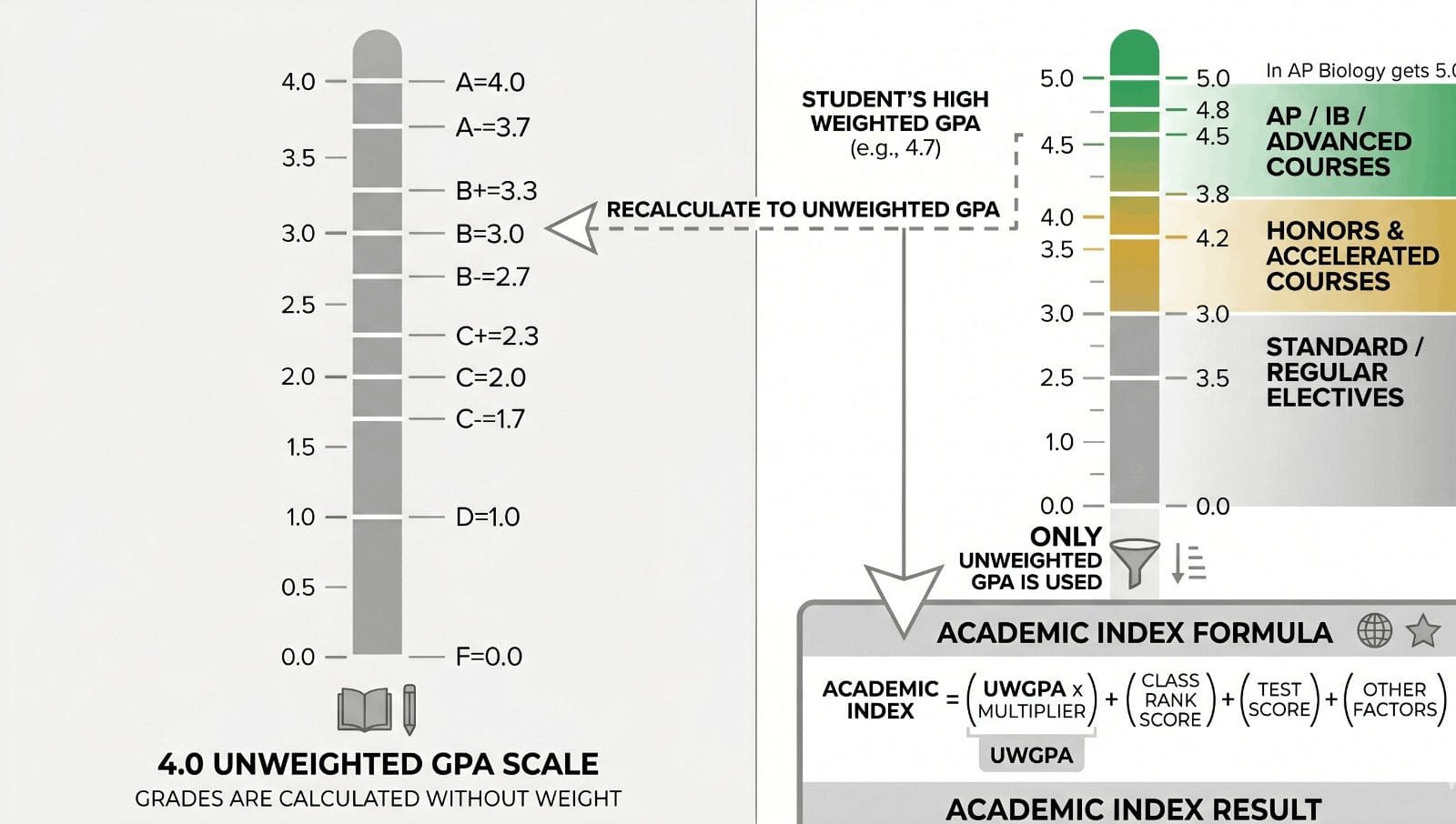
Every fall, tens of thousands of high-achieving students obsess over a single question: does my GPA look good enough for Harvard, Yale, or Princeton? Most of them, however, are asking the wrong version of it.
The real question isn’t how high your GPA is. It’s which GPA the admissions office actually plugs into its formula—and why the difference between the two numbers can define whether your application gets read at all.
Does Ivy League admissions use weighted or unweighted GPA?
Ivy League admissions offices primarily evaluate unweighted GPA. The Academic Index—an internal screening score assigned to every applicant at all eight Ivy League schools—uses unweighted GPA on a standard 4.0 scale. Course rigor is assessed separately. This approach standardizes comparisons across thousands of applicants arriving from radically different high school environments nationwide and abroad.
That’s the clean answer. But the fuller picture reveals why this distinction carries far more strategic weight than most prep guides acknowledge.
The Academic Index, first developed in the 1950s as an athletic recruitment safeguard, was designed to prevent any Ivy League school from admitting academically underqualified student-athletes for competitive sports advantage. Over decades, as application volumes ballooned, admissions offices extended the AI to every applicant in the pool. Today, as documented in Dr. Michele Hernandez’s book A Is for Admission: The Insider’s Guide to Getting into the Ivy League and Other Top Colleges, the AI functions as a threshold filter. Applications that fall below a certain score are typically screened out before a human reviewer ever touches the essay.
The GPA component of that calculation uses unweighted scores. Not the 4.5 or 5.0 you earned from stacking AP courses. The plain, un-inflated figure.
What is the Academic Index, and how does it screen applicants?
The Academic Index is a composite score on a 60–240 scale assigned to every Ivy League applicant. It combines a Converted GPA Score (CGS), derived from unweighted GPA, with standardized test scores from the SAT or ACT. Competitive applicants at Harvard, Princeton, and Yale typically need an AI above 220. Applications below 180 rarely advance to full review.
This index has evolved considerably. Originally it incorporated class rank, SAT Subject Test scores, and a converted rank score. As more high schools eliminated class rank reporting—and as the College Board discontinued Subject Tests in 2021—the Ivy League adapted the formula. The CGS replaced the converted rank score, and unweighted GPA now carries more weight in the AI calculation than it did fifteen years ago.
At the ceiling of the AI’s GPA component, a score of 80 represents a perfect 4.0 unweighted GPA. That ceiling is fixed. No number of AP courses pushes it higher.
Admissions offices also exercise flexibility when data is incomplete. At elite boarding schools—Phillips Exeter, Andover, Choate—college counselors routinely advise students to leave the GPA field blank on the Common Application. These schools don’t report weighted GPAs. Admissions officers at Harvard and Yale read those transcripts without a GPA anchor, evaluating course performance directly. It is, in miniature, exactly what every Ivy wants to do with every applicant: understand grades in context, not in isolation.
Why does weighted GPA fail the standardization test?
Weighted GPA has no universal standard. One high school may weight AP Chemistry at 5.0; another assigns identical weight to a health elective. International schools don’t offer AP courses at all. Admissions offices cannot fairly compare a 4.6 from one school district with a 4.4 from another without knowing each district’s weighting methodology—making weighted GPA largely unreliable as a cross-applicant metric.
This equity argument is decisive, and major university admissions offices have acknowledged it. Weighted GPA inadvertently advantages students from well-funded districts that offer a broad menu of honors-adjacent courses with inflated point values but lower academic demands. It disadvantages students from rural or low-income districts where AP access is limited—and effectively excludes international applicants from countries where AP simply doesn’t exist.
Using unweighted GPA as the common denominator isn’t a bureaucratic quirk. It’s a structural equity choice.
Does course rigor matter more than a student’s GPA number?
Course rigor is evaluated separately from GPA in Ivy League admissions but carries equal—often greater—strategic significance. Admissions officers review every applicant’s transcript against their high school’s School Profile, which details curriculum offerings, grading scales, and course availability. An A in an easier course actively works against an applicant when a harder course in the same subject existed at their school.
This is what most prep guides understate. The School Profile isn’t a background document. It’s a benchmark. Every grade on a transcript is read against what the student could have taken, not just what they did.
According to Ivy admissions consultants with direct reader experience, an applicant who earns an A in standard Chemistry when AP Chemistry was available has already made a legible, negative statement. Not disqualifying—but not invisible, either. The Ivy League wants students operating at the ceiling of what their environment offers.
That changes the core calculus for students still building their course schedules. A B+ earned in AP Physics reads better than an A earned in Physics I. The weighted GPA might favor the A. The admissions committee won’t.
What unweighted GPA do admitted Ivy League students actually hold?
Admitted students at Ivy League schools almost universally hold unweighted GPAs at or above 3.9 on a 4.0 scale. Harvard’s Common Data Set shows 74% of its Class of 2027 entered with a high school GPA of 4.0 or higher. Princeton considers applicants with unweighted GPAs of 3.8 or above competitive, though the median sits higher.
These figures set a floor, not a guarantee. Harvard rejects thousands of applicants with perfect unweighted GPAs every admissions cycle. With acceptance rates ranging from 3% to 10% across the Ivy League, a 4.0 is table stakes—expected, not celebrated.
What separates admitted students at this level is the convergence of a near-perfect unweighted GPA with the most demanding curriculum available at their school, consistent performance across all four years, and a transcript showing upward academic trajectory rather than scattered peaks.
Can a demanding course load compensate for a slightly lower GPA?
A rigorous course load can partially offset a GPA below the typical admitted range when the student demonstrably pursued the hardest curriculum available to them. Yale, Columbia, and Penn all state in their published admissions guidance that grades and course difficulty are evaluated in tandem. A 3.7 earned across seven AP courses reads differently than a 3.7 earned in standard coursework.
The honest boundary, though, is that context only travels so far. A 3.5 unweighted GPA produces a lower Academic Index score, and a lower AI compresses the distance holistic review can cover. The most strategic path is never a trade-off: maximum rigor, and the highest grades that rigor permits.
The smartest frame isn’t “weighted vs. unweighted.” It’s: what does my transcript tell a trained reader about my intellectual ceiling?
Ivy League admissions offices aren’t averaging your grades. They’re reading your academic biography. Your unweighted GPA is the headline. Your course choices are the story.
For students and counselors seeking official guidance on how selective institutions interpret academic credentials, the National Association for College Admission Counseling (NACAC) publishes updated annual resources on transcript evaluation standards and how institutions report through the Common Data Set framework.
Stop optimizing the weighted number. The Ivies have already decided it doesn’t drive their formula. What moves the needle is the highest unweighted GPA possible—earned in the hardest schedule your school offers.