I have covered public health long enough to know the news cycle swings hard between “next pandemic” and “it is just a cold” the moment a new variant surfaces. Neither is usually correct.
The Cicada variant — formally BA.3.2 — sits in a more complicated middle. It is not a crisis. But it is not nothing. And the specific reason scientists are watching it closely is worth understanding clearly, because most coverage so far explains what this variant is without explaining why its mutations actually matter.
What Exactly Is the COVID-19 ‘Cicada’ Variant BA.3.2?
BA.3.2, nicknamed Cicada, is a heavily mutated Omicron subvariant first identified in South Africa in November 2024. It carries 70 to 75 mutations in its spike protein — roughly double recent dominant strains like JN.1 — and was classified by the WHO as a “variant under monitoring” in December 2025.
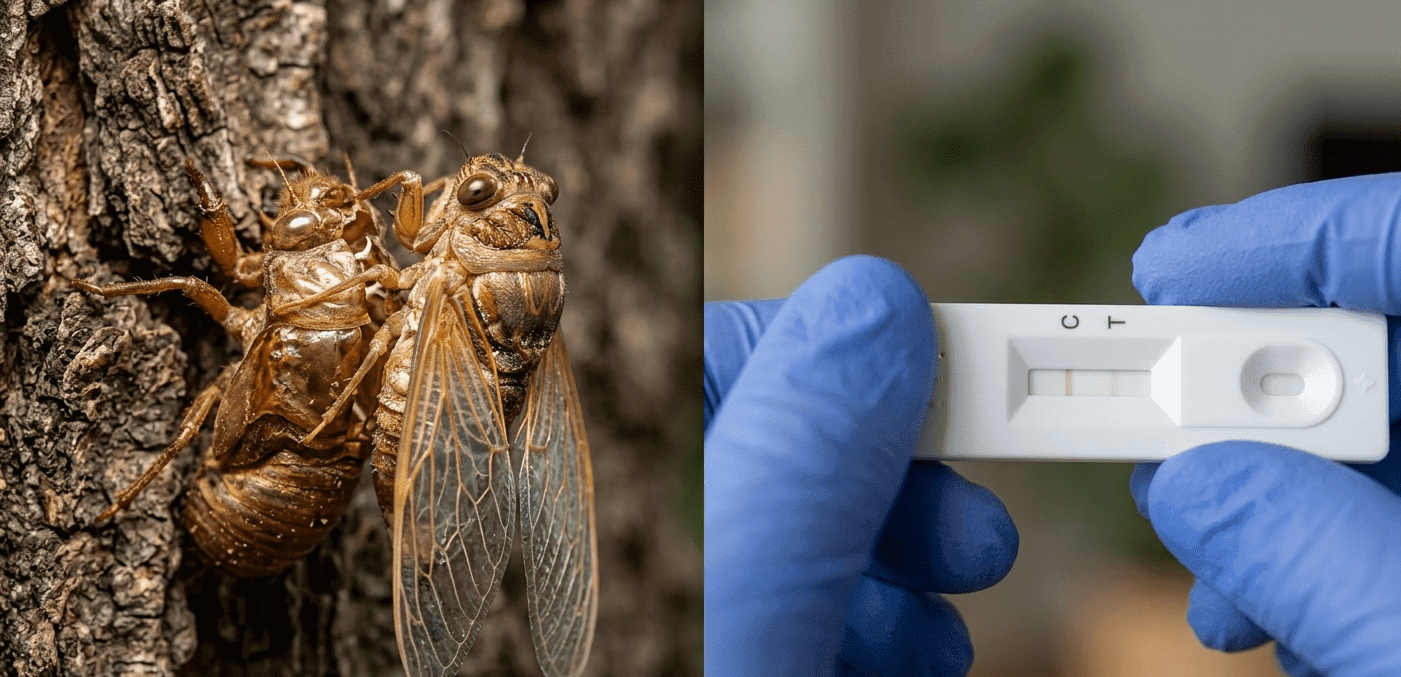
BA.3.2 descends from BA.3, an Omicron subvariant that briefly circulated in 2022 alongside BA.1 and BA.2 before fading from view — but never fully disappearing. Allied Market Research The name fits: the strain was first detected in November 2024 but attracted little attention until cases began climbing in September 2025. Mordor Intelligence Like the insect, it spent years underground before resurfacing.
What Are the Symptoms of the Cicada COVID Variant?
Cicada variant symptoms mirror standard COVID-19 — fever, cough, fatigue, headache, and congestion — but one symptom stands out: a severe sore throat described by patients as a “razorblade” sensation. Night sweats have also been reported with unusual frequency in early cases.
“Severe sore throat is reported as a common symptom along with other typical COVID symptoms,” confirmed Dr. Robert Hopkins Jr., medical director of the National Foundation for Infectious Diseases. Superteamhq
The 70 to 75 spike protein mutations mean the virus has changed exactly where antibodies from prior vaccination or infection attach. Other recent strains, such as JN.1 and LP.8.1, carry just 30 to 40 mutations on their spike protein by comparison. Institute of International Finance Your immunity is not gone — it is working harder against a changed target. If you develop these symptoms in 2026, test promptly.
How Far Has the Cicada Variant Spread Globally?
As of March 2026, BA.3.2 has been confirmed in at least 23 countries and detected in wastewater samples from 132 monitoring sites across 25 US states. It drives up to 30% of COVID cases in Denmark, Germany, and the Netherlands, and could fuel a US summer surge if vaccination rates stay low.
BA.3.2 was first detected in the US in June 2025 in a traveler returning from the Netherlands at San Francisco International Airport. Mypulse Wastewater surveillance — which detects viral material in sewage before clinical case counts rise — gave health officials advance warning. As of March 14, the variant made up 3.7% of wastewater samples. XFG remains dominant at 53% of cases. FinTechtris
For Pakistan specifically: no confirmed community transmission has been publicly reported as of late March 2026. But high-volume travel connections to Europe and the Gulf make the variant’s arrival a matter of when, not if.
How Dangerous Is the Cicada Variant Compared to Previous Strains?
The Cicada variant shows no evidence of causing more severe disease or higher hospitalisation rates than previous strains. However, its unusual degree of immune escape — bypassing vaccine-induced antibodies more effectively than recent variants — makes it a higher surveillance priority than its current case counts alone suggest.
“There’s no evidence that BA.3.2 is causing more severe disease or hospitalisations in countries where it’s more widespread,” said Dr. Adolfo García-Sastre, director of the global health and emerging pathogens institute at Mount Sinai. Mypulse
“It looks scary on paper, but it hasn’t really made a big impact in terms of disease in most places yet,” added Dr. Andrew Pekosz, virologist at the Johns Hopkins Bloomberg School of Public Health. Allied Market Research
The WHO assessed that BA.3.2 “poses low additional public health risk compared with other circulating Omicron descendant lineages.” GlobeNewswire The genuine concern is the coming summer travel season — high movement, crowded indoor spaces, and low vaccination rates create the ideal conditions for a surge.
Do Current COVID Vaccines Still Work Against BA.3.2?
Current 2025–2026 COVID vaccines, which target the JN.1 lineage, still provide meaningful protection against severe illness and death from the Cicada variant — but show reduced effectiveness against infection specifically. The fall 2026 vaccine formulation may be updated to include BA.3.2.
The COVID-19 vaccine being developed for fall 2026 may include specific protection for the Cicada variant. Generally, getting vaccinated annually provides strong baseline protection, though older adults and those with chronic health conditions may benefit from an additional dose. Bain & Company
“The new variant is still sensitive to COVID antiviral drugs,” confirmed García-Sastre. “It’s not completely clear how effective the current vaccine will be, but it likely still has some effectiveness.” Mypulse
The bottom line: reduced infection protection, but intact severe-disease protection. That distinction matters and is consistently lost in headline coverage of this story.
What Should You Actually Do Right Now?
Get your current COVID booster if you are overdue. Test immediately if symptoms develop. If positive, isolate, ventilate your space, and wear an N95 around others. Contact a doctor if symptoms worsen. No extraordinary measures beyond these are necessary.
The CDC recommends: stay home if sick, improve ventilation, wear a high-quality mask if needed, keep up with vaccines and boosters, get tested if symptomatic, and use over-the-counter medications to manage mild symptoms. FinTechtris
One thing most people overlook: check when you last received a COVID vaccine. If it has been more than twelve months and you have not had a recent infection, a booster now protects you going into a summer when this variant may be gaining ground.
For weekly updated surveillance data on BA.3.2 spread, wastewater trends, and variant proportions, the CDC’s Respiratory Virus Data Channel is the most current public resource available.
Frequently Asked Questions
Is the Cicada variant more contagious than previous strains? There is no confirmed evidence of a sustained growth advantage. “If it had really special advantages, we’d probably have seen it take off and dominate globally relatively quickly. We didn’t see that,” said Pekosz. Allied Market Research
Why is it called the Cicada variant? It was first identified in a respiratory sample from a five-year-old child in South Africa in November 2024 and remained largely undetected for months before resurfacing — mirroring the cicada insect’s dormancy pattern. Future Market Insights The name was coined by evolutionary biologist T. Ryan Gregory at the University of Guelph.
Should people in Pakistan be worried? No confirmed community transmission in Pakistan has been reported as of late March 2026. Stay current on vaccinations, and test if you develop symptoms after international travel.
Can existing antivirals like Paxlovid treat Cicada infections? Yes. Experts confirm existing COVID antivirals remain effective against BA.3.2 because they target different parts of the virus than the spike protein mutations that define this variant. Mypulse
Will there be lockdowns because of BA.3.2? No. Despite the rise in cases, experts emphasise there is no immediate cause for panic or a return to lockdowns. Future Market Insights Every public health authority has described this as a monitoring situation, not a restrictions-level event.
Will home COVID tests detect the Cicada variant? Yes. “The tests are designed to detect parts of the virus that don’t change quickly,” said Dr. Donald Milton, an expert at the University of Maryland. Just make sure your test kit is not expired. Bain & Company